
-
Iconic Impressions Advertising
- July 15, 2026
- No Comments
Large Format Printing Mistakes Businesses Should Avoid
Table of Contents
- Key Takeaways
- Choosing the wrong print material
- Ignoring image resolution quality
- Forgetting weather and location factors
- Common file setup mistakes
- Skipping the proof stage
- Poor design and text sizing
- Not hiring an experienced printer
- Wrapping it up
- Frequently asked questions
Key Takeaways
- If you choose the wrong material, you are not going to be able to enjoy your outdoor print for very long in Dubai’s climate.
- A clear photo on a cell phone may become blurry when blown up on a banner.
- Without the Proof stage you will end up paying for it later, both in terms of time and money.
- A reliable and professional large format digital printing services provider in Dubai can prevent most of these issues from becoming a reality.
Businesses can be seen in Dubai with the help of banners, hoardings, vehicle wraps, and shop signs. But a lot of prints fade, crack, or simply do not turn out as desired due to minor blunders prior to printing.
With proper planning, most of these problems can be prevented. There are some common mistakes when using large-format digital printing in Dubai; if you know these mistakes, you can get better results and save money.
At Iconic Impressions Advertising, they’ve seen these issues at retail stores, construction sites, and numerous other locations. Fortunately, they are easy to prevent if you know what to look for.
Choosing the wrong print material
Not every material suits every job. A banner made for a shop window won’t hold up for months on a rooftop hoarding under the Dubai sun, and this mismatch is probably the single most expensive mistake businesses make.
Therefore, some materials fade within weeks in direct sunlight. Others tear in strong wind or start peeling once humidity sets in. Get the material wrong and you’re often reprinting the same job a month later.
Here’s how the common options compare:
| Material | Best Used For | Weather Resistance | Typical Lifespan |
|---|---|---|---|
| Vinyl Banner | Outdoor banners, hoardings | Good | 1-2 years |
| Flex Banner | Shop signs, event backdrops | Moderate | 6-12 months |
| Mesh Banner | Building wraps, windy areas | Excellent | 1-2 years |
| Foam Board | Indoor displays, exhibitions | Poor (indoor only) | Few months |
| Acrylic Sheet | Premium signage, reception boards | Excellent | 3-5 years |
Before you settle on a material, think through where it’s going, how long it needs to last, and whether it’ll be fighting sun or rain the whole time.
Ignoring image resolution quality
A logo that looks sharp on your screen can turn grainy and pixelated once it’s printed at billboard size. The reason is simple: screens and printers don’t read resolution the same way.
A lot of designers work from images pulled for web use, which fall apart once scaled up. Stretch a small web photo across a 10-foot banner, and every flaw in it becomes obvious from across the street.
A few things help here:
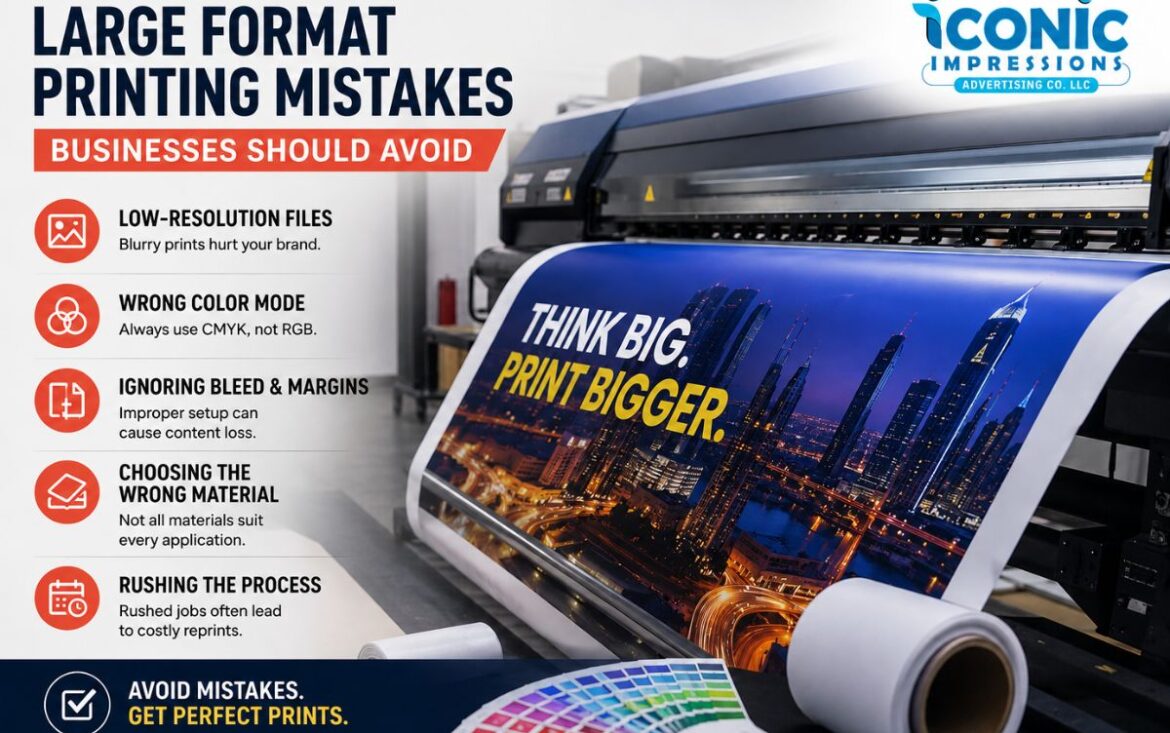
- Work with high-resolution files, somewhere around 150 to 300 DPI for large prints.
- Skip images pulled straight off websites or social media.
- Ask your design team for the original, uncompressed file.
- Print a small test section before committing to the full size.
- Getting this right the first time means one print run instead of two.
Forgetting weather and location factors
Dubai isn’t gentle on printed material. Heat, humidity, sandstorms, and constant sun exposure wear down faster than most people expect, and businesses that skip this step end up with faded colors or peeling edges within a few months.
A print hanging inside an air-conditioned mall needs nothing like the treatment a print outside a warehouse. Location changes the ink, the lamination, and sometimes the material itself.
Worth checking before you print:
- Is it facing direct sun most of the day?
- Will it be exposed to sand, dust, or wind?
- Does it get washed or cleaned regularly?
- Is this a one-season print or a multi-year one?
Moreover, UV-resistant inks and the right lamination go a long way toward keeping colors from washing out under that kind of sun.
Common file setup mistakes
A file that looks great on a laptop screen doesn’t always convert once it reaches a large-format printer. Print files simply behave differently from files built for screens.
The errors we see most:
- RGB color mode instead of CMYK, which shifts colors once they’re printed.
- Missing bleed margins, leading to white edges or text getting cut off.
- Fonts embedded incorrectly, causing text errors mid-print.
- Flattened files with no layers, which makes fixing anything at the last minute nearly impossible.
However, confirm file specs with your printer before you send the final artwork. That one check saves most of the headaches later.
Skipping the proof stage
Going straight from design to full print run is one of the costlier shortcuts a business can take. A proof, whether it’s digital or physical, shows exactly how the print will turn out before production starts.
Skip it, and you won’t catch color mismatches, spelling errors, or sizing problems until the job’s already done, which is the worst time to find out.
What proof actually does for you:
- Confirm the printed colors match your brand.
- Catches typos and layout issues before mass printing.
- Shows true scale, which is hard to judge on a screen.
- Avoids the cost of reprinting an entire order.
Therefore, the short wait for a proof is nothing compared to reprinting a full banner run.
Poor design and text sizing
Text that reads fine on paper doesn’t always hold up at billboard size. What looks readable up close can disappear entirely from a distance, which defeats the whole point of going large format.
Mistakes you see often:
- Thin fonts that vanish from a few meters away.
- Too much text crammed onto one banner.
- Low-contrast colors that blend right into the background.
- Key information is placed too close to the edges, where it risks getting cropped.
One rough test: if you can’t read the text clearly from about 10 steps back on your screen mockup, it probably won’t read from the actual viewing distance either.
Not hiring an experienced printer
Some businesses go with whoever’s cheapest, without checking if that provider actually has large-format experience. It usually shows, in color, that’s slightly off, materials that don’t hold up, or deadlines that slip.
An experienced provider already knows Dubai’s weather, the right materials for each job, and what outdoor advertising here actually demands. Large format digital printing in Dubai takes more than a big machine. It takes someone who’s dealt with these conditions before.
At Iconic Impressions Advertising, they stay involved from the design stage through installation, which is where most of the mistakes above get caught early. The right partner tends to show in the final result, not just the price quote.
Wrapping it up
If you want to get your brand seen, there’s no better solution than large-format printing. However, if there are any mistakes, it will result in poor-quality prints, the loss of materials, and additional expenses. By selecting an appropriate material, working with high-resolution files, and reviewing the print proof, you can minimize these issues.
For any banner, hoarding, or signage project, it is advisable to hire a printing company that has experience in the printing industry. If you want a second time at the rate you may be looking for, then you are looking for a reliable large format digital printing service in Dubai which is provided by Iconic Impressions Advertising. So, give us a call today to talk about the next project.
Frequently asked questions
10X10 is a printing technique for large prints such as banners, hoardings, and vehicle wraps, typically used for outdoor marketing and company signage throughout Dubai.
Regular inks fade quickly with constant heat and exposure to the sun. When paired with the right lamination, prints can retain color for much longer with the use of UV-resistant inks.
For most large-format prints, the desired DPI is between 150 and 300. Something lower will look blurry or pixelated when it is seen enlarged on a banner.
It depends on the materials used. Simple banners could end up being used for several months, and weatherproof ones such as mesh or acrylic may last for several years.
AI- or EPS-format files are best. Very detailed designs or photo-heavy designs also work well with high-resolution PDF or TIFF files.
A proof is a real color, sized, and laid-out document that is created prior to going to full production, thereby allowing mistakes to be caught as early as possible before expensive reprints are made.
Vinyl and mesh banners are great for outdoor environments because they’re weather-resistant, and acrylic is ideal for high-quality signage that will last longer.
Seek local experience, good material knowledge, and a correct proofing procedure. These two things are usually mean prints that are long-lasting and look professional.