

-
Iconic Impressions Advertising
- September 19, 2026
- Comment (1)
What Are Industrial Metal Nameplates and Where Are They Used?
Table of Contents
- Key takeaways
- What industrial metal nameplates actually are?
- Why was metal chosen over other materials?
- Common types and marking methods
- Where they’re used (real industry applications)
- How does Dubai metal branding fit into this?
- The fabrication and cutting process
- Choosing materials for Dubai’s climate
- Cost and durability factors
- Common mistakes when ordering nameplates
- Wrapping up
- Frequently asked questions
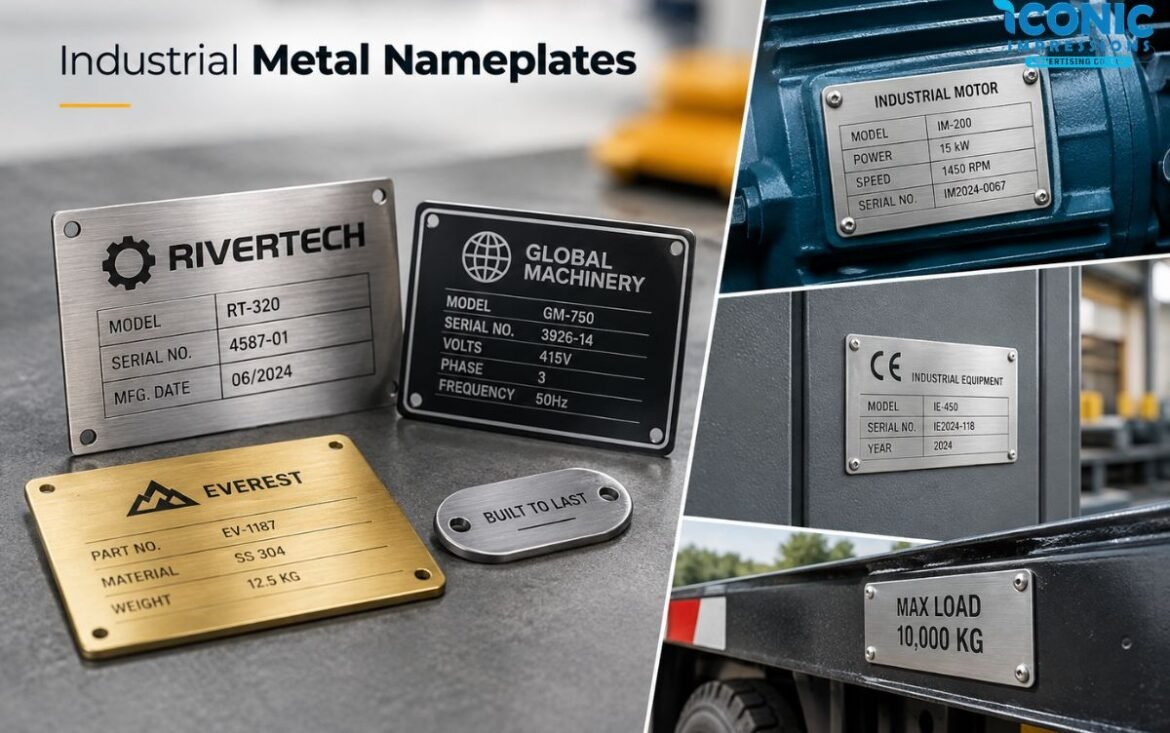
A piece of industrial metallic nameplate is a small metallic sheet, usually made of stainless steel, aluminum, or brass, that is permanently attached to machines or apparatuses in order to provide information such as model number, serial number, voltage rating, manufacturer’s name, or safety alerts. They can be found on every piece of machinery used, from HVAC units and electrical panels to construction machinery and laboratories. Their purpose is not decoration. It is functional in its essence: technicians, inspectors, and operators rely on this plate to know how to deal with a machine long after its documents have been lost over the years.
Key takeaways
- Industrial metal nameplates show details about equipment, including the ratings and warnings about how to comply with all the requirements.
- Moreover, the materials used in making them, such as stainless steel or anodized aluminum, are capable of withstanding moisture, heat, and chemicals.
- At present, Dubai’s laser cutting services offer their customers accurate tolerances and speedy nameplate production.
- Metal branding usually means cutting the material precisely and applying weather-resistant finishes.
What industrial metal nameplates actually are?
Think of a nameplate as the equipment’s ID card. It is permanently fixed to a machine when it is assembled by riveting, screwing, or adhesive bonding, and will remain so for the life of the product, often for 15 to 20 years in outdoor or industrial environments. It’s a long distance for a label to last, so paper stickers or plastic tags are not going to work here.
A typical nameplate carries:
- The model number and serial number.The model and serial numbers.
- Voltage, amp or pressure ratings
- Manufacturer Name and Manufacturing Country
- Certification marks (CE, UL, ISO)
- Safety information, warnings, or operating instructions
Why was metal chosen over other materials?
Labels made from plastic crack in the presence of UV. Paper is destroyed by heat or moisture within months. That’s not something that metal has. Stainless steel is virtually unaffected by corrosion in coastal or high-humidity environments, and after anodization, aluminum is scratch- and chemical-resistant, yet lightweight.
Additionally, durability is very important- until it’s no longer functional. The nameplate of a generator or compressor may be outdoors for 10 years without maintenance, in the sun, rain, and vibrations. Replacing a faded text or corroded plate isn’t easy. Machinery may need to be taken out of service and, in industries that require an inspection, a poorly legible nameplate is essentially a pass or fail item.
Common types and marking methods
There isn’t one way to make a metal nameplate. The technique will vary depending on the material, the quantity required, and the level of ruggedness of the operating environment.
- Etching: An acid or chemical process takes away surface material to form the design, and recessed areas are filled with resin paint to provide contrast. Ideal for fine graphics and outdoor use.
- Engraving: This is the process of cutting into the metal by use of a cutting tool or laser beam. Text is inlaid into the surface, resistant to wear even with heavy use.
- Laser marking: A concentrated beam of light burns or changes the surface colour. Fast and accurate, suitable for serial numbers or bar codes which vary per unit.
- Embossing/Stamping: Text that is raised or debossed into the metal; often used on older-style or heavy-duty tags.
However, etched plates are generally more graceful and are preferred for plates that are heavily branded. When runs are large, laser marking is superior in terms of speed and consistency.
Where they’re used (real industry applications)
Metal nameplates are not limited to any industry:
- Manufacturing Plants – Machine specifications, Maintenance plans, Hazard warnings on CNC equipment and conveyor systems
- Electrical and electronics – Control panels, transformers, switchgear, where voltage and amperage ratings must be visible and legally required.
- Aluminum- Ffuel tank caps, hood latches, door panels, wheels, vents, hatches, and door locks
- Construction and structural steel- Equipment tags on cranes, generators, and site machinery
- Oil, gas, and marine- Corrosion-resistant plates on pipelines, valves, and offshore equipment
- Medical and lab equipment – Calibration date, lab model number, sterilization directions
They all have varying requirements for durability. A nameplate on a marine piece of equipment must withstand salt spray, but one on a lab centrifuge will just have to endure cleaning chemicals and frequent handling.
How does Dubai metal branding fit into this?
In Dubai, metal branding is frequently lumped together with signage and nameplates, as the process is very similar. The procedure for cutting, etching, and finishing is identical regardless of whether it is for use as a corporate reception sign, vehicle branding plate, or equipment nameplate. The difference is scale and intent: branding plates are judged by how easy it is to read the logo from a distance; industrial nameplates are judged by how easy it is to read the fine print, year after year, up close.
In Dubai, companies working across signage, interiors, and industrial fabrication often handle both under one roof, since the machinery and finishing techniques overlap anyway. Iconic Impressions Advertising, for instance, works across acrylic displays, vehicle branding, and metal signage, which puts nameplate-adjacent fabrication squarely within that scope.
The fabrication and cutting process
Metal fabrication in Dubai for nameplates generally follows a sequence, though exact steps vary by supplier and material.
- Material selection– stainless steel, aluminum, or brass, chosen based on environment and budget
- Surface preparation – cleaning off oils and oxidation before any marking begins
- Cutting to shape– usually via laser cutting services fabricators offer, since laser cutting holds tighter tolerances than manual shearing
- Marking – etching, engraving, or laser marking the actual text and graphics
- Finishing– deburring edges, filling etched recesses with paint, applying protective coatings
- Mounting prep – drilling holes for screws or applying adhesive backing
Laser cutting services Dubai shops use today can hold tolerances tighter than half a millimeter on most metals. That matters more than it sounds when a nameplate has to sit flush in a recessed panel or line up with mounting holes on imported machinery.
Choosing materials for Dubai’s climate
Local conditions genuinely change what material makes sense here. Dubai’s heat, humidity swings, and coastal air push corrosion faster than drier climates do.
- 316-grade stainless steel handles salt air better than 304-grade, worth the extra cost near the coast.
- Anodized aluminum works fine indoors or in shaded outdoor spots but degrades faster under direct, sustained sun than stainless does.
- Adhesive mounting can weaken in extreme heat, so mechanical fastening (screws or rivets) is usually the safer call for outdoor industrial plates.
Therefore, metal fabrication services in Dubai that deal with industrial clients regularly factor these conditions into material recommendations, rather than defaulting to whatever’s cheapest on the quote sheet.
Cost and durability factors
Pricing mostly comes down to three things: material grade, marking method, and order volume.
| Factor | Lower Cost Option | Higher Cost, Longer Life |
| Material | Aluminum | 316 Stainless Steel |
| Marking | Laser marking (bulk) | Deep etching with paint fill |
| Mounting | Adhesive | Riveted/screwed |
| Order size | Small batch | Bulk production runs |
Bulk orders bring the per-unit price down noticeably, since setup costs like die-cutting templates and laser programming spread across more units. A one-off custom nameplate will always cost more per piece than a run of 500.
Common mistakes when ordering nameplates
A few recurring issues worth flagging before placing an order:
- Choosing adhesive mounting for outdoor equipment exposed to heavy vibration or heat
- Skipping corrosion-grade material to save cost, then replacing the plate within two years anyway
- Not specifying font size relative to viewing distance, so the text is technically compliant but hard to actually read
- Ordering without confirming which local certification symbols the industry requires (electrical, medical, etc.)
Moreover, getting the spec sheet reviewed by whoever’s doing the metal fabrication in Dubai before production starts avoids most of this.
Wrapping up
Nameplates look like a minor detail, but the information on them- identification, compliance, safety- outlives the paperwork and often the people who ordered them. Getting the material, marking method, and mounting right the first time saves both money and hassle down the line, particularly in a climate like Dubai’s where heat and humidity don’t forgive weak material choices.
Furthermore, the fundamentals don’t really change whether it’s a straightforward equipment tag or something closer to metal branding in Dubai for signage and vehicles: durable material, a marking method suited to where the plate will actually sit, and cutting precise enough that nobody’s fixing alignment problems after installation.
Frequently asked questions
Engraving physically cuts into the surface with a tool or laser, leaving inlaid text. Etching uses chemicals to corrode the design into the metal, usually followed by paint fill for contrast and visibility.
316-grade stainless steel generally outperforms aluminum and 304-grade steel in coastal or high-humidity environments, resisting salt corrosion for well over a decade with minimal maintenance.
Yes. Laser marking handles variable data like serial numbers or barcodes efficiently, since each plate can be programmed individually without changing tooling between units.
Most range between 0.5mm and 1.5mm depending on mounting method and durability needs. Thicker plates suit riveted, high-vibration installations; thinner ones work for adhesive-mounted indoor equipment.
For complex shapes or tight tolerances, yes. Laser cutting services Dubai suppliers provide typically achieve cleaner edges and finer detail than mechanical stamping, especially for small production runs.
Depends on the industry. Electrical equipment often requires CE or UL-compliant markings; medical devices may need specific regulatory symbols. Confirm requirements before finalizing the design.
Usually it’s material mismatch for the environment, cheap paint filling in the etched recesses, or a UV-sensitive coating breaking down under direct sun over time.
In most cases, yes, especially with screw-mounted plates. Adhesive-mounted plates need more careful removal so the underlying surface doesn’t get damaged.
1 Comment
Top Metal Branding Solutions for Businesses in Dubai
[…] when shortlisting metal fabrication services in Dubai, ask for photos of finished work in similar conditions. Iconic Impressions Advertising, for […]