

-
Iconic Impressions Advertising
- September 23, 2026
- Comment (1)
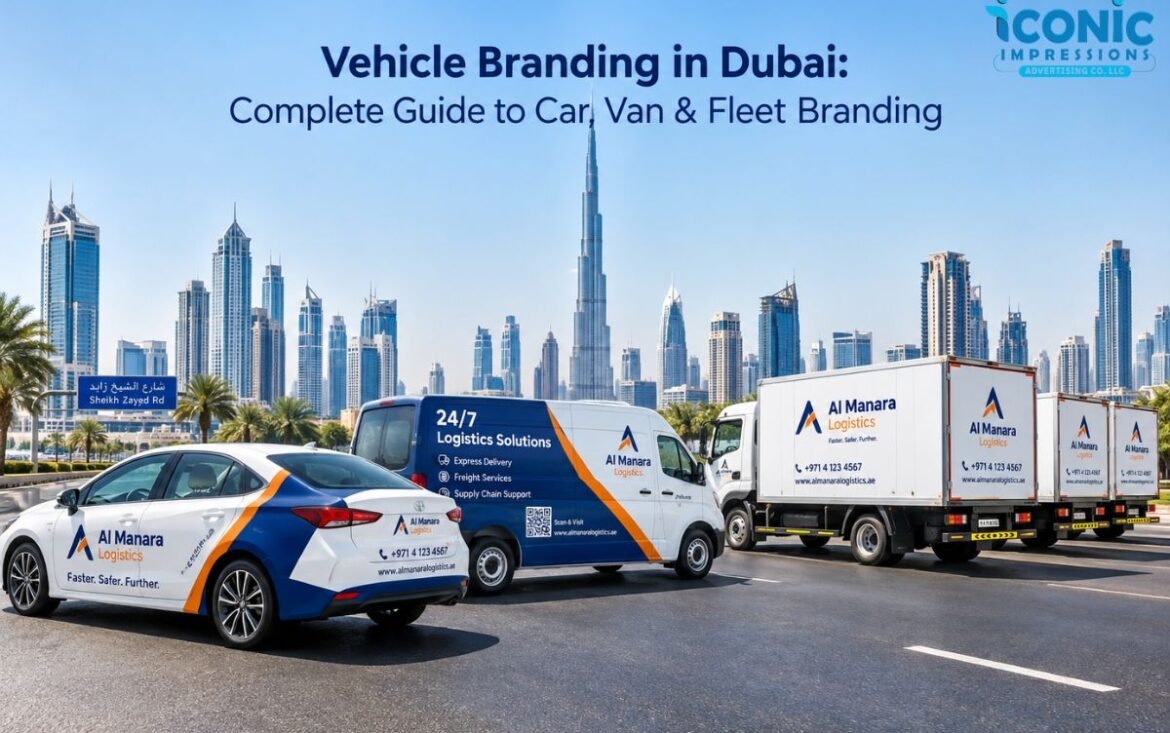
Vehicle Branding in Dubai: Complete Guide to Car, Van & Fleet Branding
Table of Contents
- Key takeaways
- What vehicle branding actually means?
- Types of vehicle branding: wraps, decals, lettering
- Car branding vs van branding vs fleet branding
- RTA rules you need to follow
- Materials that matter (cast vs calendered vinyl)
- Cost factors explained
- The branding process: step by step
- Common mistakes to avoid
- Maintenance tips
- Conclusion
- Frequently asked questions
Vehicle branding in Dubai is an effective way of advertising for your business. It is applied with vinyl wraps, decals, or letters on vehicles, including cars, vans, and fleet vehicles, which helps your logo and contact information travel with the vehicle wherever it goes. But before you start enjoying all the benefits of vehicle branding, you may need to go through regulations created by the Roads and Transport Authority (RTA).
These regulations are the most underestimated aspect of vehicle branding. Applying vinyl wraps on your vehicle may not seem like a difficult task, but it is certainly not something you do yourself and hope for the best. Making a mistake can lead to fines and inspections of your vehicle matching the permits.
Key takeaways
- Everything regarding commercial branding permits and personal colour-change wraps is treated differently in terms of regulations.
- A commercial vehicle’s branding can cover a maximum of half the surface area, with half of this amount written in Arabic.
- Cast vinyl is more adaptable to both curves and heat in Dubai than calendered vinyl.
- Pricing will depend on the size of the vehicle, material, complexity of the design, and the quantity of the fleet as well.
Why do businesses bother with it?
A branded delivery van isn’t just decoration sitting in traffic. It’s parked outside client sites, sitting in supermarket lots while a driver runs errands, stuck at the same red light as fifty other cars. Against a billboard, the cost per person who sees it is low, and it keeps working every single time the vehicle moves.
Why companies actually spend money on this:
- For service businesses, plumbers, electricians, cleaning crews, a branded vehicle builds trust before the phone even rings.
- It keeps a delivery or sales fleet looking like one company instead of five random cars.
- You pay once, and it keeps advertising for years, unlike a print campaign you have to renew.
- Vehicle branding company in Dubai like Iconic Impressions Advertising, which handle signage and acrylic displays alongside vehicle branding, often fold this into a bigger offline branding push rather than treating it as a standalone job.
Types of vehicle branding: wraps, decals, lettering
You don’t need a full wrap just because someone tries to sell you one. There are a few levels here, and which one makes sense depends on your budget and how loud you want the branding to be.
- Vinyl lettering – letters cut from solid vinyl. Fine for a company name, phone number, or a simple logo. Cheapest route, but no gradients or photos.
- Spot graphics – printed rather than cut, applied to specific panels like doors or the tailgate. Full colour, gradients, whatever the logo needs.
- Partial wrap – covers more ground, usually the sides and rear, while leaving the roof and a few panels bare.
- Full wrap – the whole body, sometimes with a colour change built in. Biggest visual impact, highest cost, and the most regulated option if it’s a personal vehicle.
Therefore, the real question is how much of the vehicle you want doing advertising work, and whether it’s client-facing daily or mostly running internal errands.
Car branding vs van branding vs fleet branding
People use these three words like they’re the same thing. They’re not, once you get into the details.
| Aspect | Car Branding | Van Branding | Fleet Branding |
| Typical use | Sales reps, small business owners | Delivery, trades, service calls | Multiple vehicles under one identity |
| Surface area | Smaller, curved (doors, bonnet) | Larger, flatter panels | Mixed, needs a design that scales |
| Design priority | Compact logo, contact info | Bold, readable from a distance | Same look across every vehicle |
| Common material | Cast vinyl for the curves | Calendered vinyl works fine here | Depends on the vehicle mix |
| Cost pattern | Lower per unit | Moderate, more surface | Usually bulk pricing |
Fleet branding is genuinely its own project. Ten or twenty vehicles means consistency matters more than any single clever design choice. A logo that looks great on one van has to hold up on a different model, a different colour, parked next to five others outside a warehouse at 6 am.
RTA rules you need to follow
This is where people trip up, because personal and commercial vehicles play by different rulebooks.
For personal vehicles, only a colour-change wrap is allowed, and it has to match what’s on the Mulkiya. Get a mismatch and you’re looking at delays at inspection, renewal, or ownership transfer.
For commercial and fleet vehicles, the advertising rules go further:
- Branding can’t cover more than 50% of the vehicle’s surface.
- Half the advertised content has to be in Arabic, matching the trade licence name.
- English and Arabic only. Nothing else.
- Windshields stay completely clear, no exceptions.
- Nothing can block the driver’s view, the plate, or the lights.
- No offensive content, and whatever’s advertised has to match the trade licence.
- A police NOC is required for 3D images, real people’s photos, or full colour-change wraps.
- Only commercial or fleet-registered vehicles can carry ads. A personal car doesn’t qualify even if you run a business out of your garage.
Permits run for about a year and need renewing. Rough numbers: around AED 1,000 a year for a full commercial wrap permit, AED 1,500 for heavy or refrigerated vehicles, and about AED 120 for a colour-change registration update. Commercial branding permit costs shift depending on what’s actually being applied.
Skip this step, and it costs more later: fines, failed inspections, renewal headaches. The permit fee is the cheap part.
Materials that matter (cast vs calendered vinyl)
- Vinyl isn’t vinyl. The choice you make here decides how the wrap looks in year one and whether it still looks decent in year four, and Dubai’s heat makes that gap wider than most places.
- Cast vinyl is thin, flexible, and wraps around mirrors and door handles without a fight. It holds up in high heat instead of shrinking, and with decent care it can go past five years. Costs more going in, holds its shape better coming out.
- Calendered vinyl is thicker and stiffer. It’s fine on flat panels, box trucks, trailers, nothing with much of a curve. Cheaper, but it tends to lift or shrink sooner, especially parked in direct sun for months on end.
Rounded panels on a car usually make cast vinyl worth the extra cost. A flat-sided van or trailer can get away with calendered vinyl without losing much.
Cost factors explained
There isn’t one number here. Too many variables:
- Vehicle size – an SUV or a large van simply has more surface than a hatchback.
- Coverage – lettering costs a fraction of what a full wrap does.
- Material grade – cast costs more than calendered, but usually earns it back in lifespan.
- Design complexity – a photo-realistic graphic takes longer to print and apply than a flat logo.
- Number of vehicles – fleet jobs reuse the same design work, so bulk pricing is common.
- Old wrap removal – an existing wrap has to come off first, and that’s an extra line item.
- Installer skill – a rushed job leaves bubbles and peeling edges, and then you’re paying to redo it sooner than planned.
Rough guide: basic lettering can start in the low hundreds of dirhams. A full printed wrap on a mid-size vehicle can run into several thousand, depending on material and how detailed the design is.
The branding process: step by step
- Design and brand consultation – what goes on the vehicle, logo, contact info, tagline, and how much surface it covers.
- Material selection – cast or calendered, based on the vehicle’s shape and how long you want it to last.
- Printing and lamination – graphics get printed and laminated for UV and scratch protection.
- Permit and NOC approval – commercial designs need RTA sign-off first, and some content needs police clearance too.
- Surface preparation – the vehicle gets properly cleaned, and any old wrap or damage gets dealt with before anything new goes on.
- Installation – vinyl goes on panel by panel, heat-shrunk around curves, and checks for bubbles as it goes.
- Final inspection – edges, seams, and a check against the approved design.
Common mistakes to avoid
- Going with the cheapest quote without asking whether it’s cast or calendered vinyl.
- Skipping the RTA permit because a small logo “doesn’t really count” as advertising.
- Finding out about the Arabic-text rule only when the vehicle fails inspection.
- Wrapping over chipped paint, which shows through and cuts the wrap’s life short.
- Leaving the design to the last minute on a fleet job, then scrambling when permit approval takes longer than expected.
Maintenance tips
A wrapped vehicle needs a little more attention than a painted one. Skip automatic car washes with hard brushes; they lift edges over time. Hand washes with something wrap-safe instead. Parking in shade when you can slow down fading, which matters more here than in most places given how long and how hard the sun works for most of the year.
Conclusion
Vehicle branding in Dubai works when you treat it as two projects at once: getting the compliance right and getting the design right. Nail the material and the design, and it quietly does its job for years. Miss the RTA side, and even a wrap that looks great becomes a problem the day your registration comes up for renewal.
If you’re weighing this against other offline branding, signage, displays, that kind of thing, working with a team that handles both the creative and the permit side, like Iconic Impressions Advertising, usually saves you from juggling two vendors and two timelines.
Frequently asked questions
Wrapping usually just means covering the body in vinyl, sometimes purely for a colour change. Branding adds a logo, contact details, or advertising content, which is what brings RTA advertising rules into play.
No. RTA rules only allow advertising content on commercial or fleet-registered vehicles; personal cars don’t qualify, even if the business is yours.
Cast vinyl with proper care usually holds up 3 to 5 years. Cheaper calendered vinyl, or a rushed install, can fail well before that in the heat.
Generally yes. Any commercial vehicle carrying advertising needs a permit, and the size of the logo doesn’t exempt it from the coverage or language rules.
Cast, for full wraps. It handles curves and heat without shrinking. Calendar is built for flat surfaces like trailers, not a full body.
Up to 50% of the surface, and at least half of that content needs to be in Arabic.
Fines, failed inspections, or delays at renewal and ownership transfer.
Usually. The design work gets reused across the fleet, and installers tend to offer bulk pricing when several vehicles go through at once.
1 Comment
How Vehicle Branding Boosts Local Visibility in Dubai
[…] Vehicle branding in Dubai works well because it matches the way people travel around the city. Branded vehicles receive repeated exposure from the heavy traffic, regular routes, and busy areas where homes and businesses are close together. […]