
-
Iconic Impressions Advertising
- August 4, 2026
- No Comments
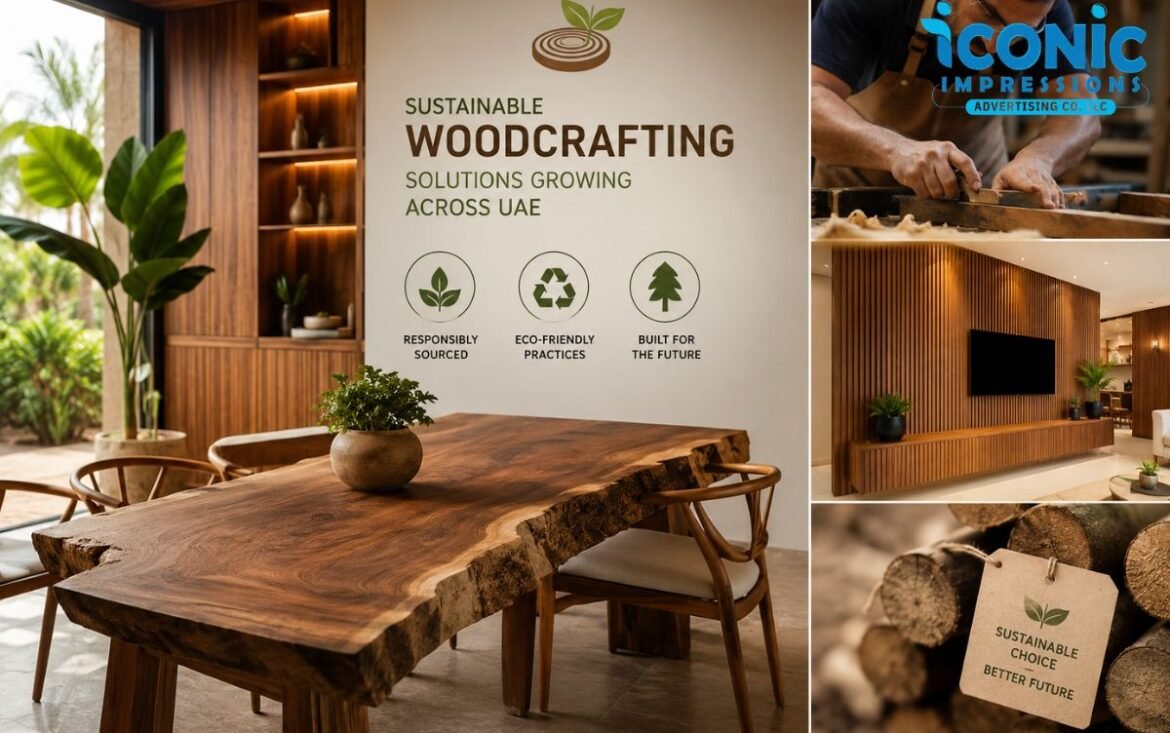
Sustainable Woodcrafting Solutions Growing Across UAE
Table of Contents
- Key takeaways
- What woodcrafting services actually cover in Dubai?
- Materials behind the shift toward eco-friendly wood
- What to look for in display stand suppliers?
- Why do businesses turn to custom display stands suppliers?
- Where bespoke acrylic products suppliers fit in Dubai?
- Common mistakes businesses make with woodcrafting projects
- How to choose the right woodcrafting partner?
- Conclusion
- Frequently asked questions
Key takeaways
- Sustainable wood crafting practices help reduce material waste by using reclaimed and FSC certified wood.
- Wood and acrylic create stunning and durable display solutions.
- With in-house fabrication, it is possible to achieve greater quality than with outsourcing.
- The durability of a display stand depends on the quality of material used, finishing, and the technique of joinery.
Dubai’s interior and retail sectors have quietly shifted their material priorities over the past few years. MDF and laminate used to dominate shopfitting and exhibition builds. Solid wood and reclaimed timber are showing up in more proposals now, partly because clients are asking for them and partly because suppliers have simply gotten better at sourcing them affordably.
Regulation plays a part in this. Dubai’s Al Sa’fat rating system pushes commercial fit-outs toward lower-emission materials and better waste management on site. The demand aspect is much more important as hospitality firms and retailers are in search of designs that not only click with Instagram users but also withstand traffic, which is possible with wood if it is sourced and treated properly.
Before, people used to rely on synthetic boards to do their jobs but nowadays fabricators have started using the FSC-certified plywood, reclaimed teak, and low VOC finishes as the default option.
What woodcrafting services actually cover in Dubai?
The concept is very broad in its usage, thus a clear definition should be provided. The concept of woodcrafting services in Dubai refers to the process of creating custom furniture, executring joinery for offices and shops, constructing exhibition stands, providing signage backing, and making decorative wall panels that together build the woodcrafting process. Some companies are involved in repair or futher restoration of the wood product instead of its replacement.
As a rule, a woodcrafting project consists of four main stages, namely, project design, material selection, manufacture and installation at the clients’ location.
It is important to note that the design stage is more important than clients might originally think. A situation when bad joinery or wrong type of wood is chosen often leads to the problems of distortion and further wood cracking due to the change of humidity levels in a one-year period.
High-quality woodworkers understand in which conditions the wood product will be used, thus they will choose appropriate materials. For example, the reception desk used in an air conditioned office will be treated differently as compared to the outdoor cafe bar counter exposed to wind and sea.
Materials behind the shift toward eco-friendly wood
Three material choices come up again and again in sustainable projects.
Reclaimed timber comes from decommissioned structures or offcuts, which reduces demand for new logging while giving pieces a grain character you can’t fake. In the UAE, one can easily procure FSC-certified plywood through local distributors. It’s made from sustainably managed forests, so it’s a suitable choice for different woodworks. One can also use bamboo composite materials, which is also eco-friendly. Bamboo is technically a grass, so it’s as tough as wood but grows much more quickly than conventional trees.
The best materials depend on each respective project; reclaimed wood is ideal for furniture and decorative items. On the other hand, if consistent quality is needed, FSC-certified plywood is the best choice. Bamboo is great for indoor furniture and panels but is not effective for outdoor use since it does not endure the UAE’s heat and humidity as well as treated hardwoods do.
What to look for in display stand suppliers?
Retail and exhibition clients rarely need custom furniture. What they need is a display unit that survives repeated assembly, transport, and handling, and that’s a different set of demands than general joinery work. Display stands suppliers in Dubai have to account for stackability, shipping weight limits, and quick reassembly at trade shows or pop-up locations.
However, a well-built stand holds its joints after multiple setups without needing re-gluing or reinforcement. Suppliers who cut corners on joinery, relying on adhesive alone instead of combined mechanical fastening, tend to produce units that loosen after a handful of uses. It’s worth asking a supplier directly how their stands hold up after repeated disassembly. That detail almost never shows up in a portfolio photo.
Why do businesses turn to custom display stands suppliers?
Off-the-shelf stands work fine for generic retail setups. But brands with specific space constraints, unusual product dimensions, or particular branding requirements usually need something built to spec rather than adapted from a standard mold. That’s the demand custom display stands suppliers in Dubai are built around.
The trade-off is time. Custom builds take longer than stock units, so brands planning around a launch or a seasonal campaign need to budget for a realistic production window, usually two to four weeks depending on complexity, though rush orders are sometimes possible for a premium.
Where bespoke acrylic products suppliers fit in Dubai?
Wood and acrylic aren’t competing materials here. They’re usually paired. A wooden base with an acrylic riser gives a display unit structural weight along with a clean, modern top section for showcasing smaller products, and that combination is a big part of why bespoke acrylic products suppliers in Dubai stay busy- acrylic handles fine detailing, laser-cut branding, and lighting integration in ways solid wood can’t easily match.
Therefore, the practical difference comes down to durability versus flexibility. Wood holds up better under heavy daily use and gives off a warmer visual texture. Acrylic allows for sharper edges, transparency, and easier custom shaping. A lot of retail and exhibition projects in Dubai now specify both materials in the same brief, splitting the work between a wood fabricator and an acrylic specialist, or increasingly, one supplier who handles both under one roof.
Common mistakes businesses make with woodcrafting projects
- Skipping a site assessment- Ordering furniture or displays without measuring the actual installation environment leads to sizing mismatches and humidity-related warping later on.
- Picking a finish for how it looks, not how it performs- A finish that looks great on a showroom sample may not survive UV exposure near windows or at outdoor kiosks.
- Underestimating lead time- Custom work, especially with reclaimed timber, needs more sourcing and drying time than standard board materials, and rushing it shows.
- Never asking about joinery method- Adhesive-only construction is cheaper up front but fails faster under repeated handling than mortise-and-tenon or dowel joints.
How to choose the right woodcrafting partner?
A few practical questions tend to separate a reliable fabricator from one that’s just quoting low.
| Question to Ask | Why It Matters |
| Do you fabricate in-house or outsource? | In-house control usually means better quality checks and fewer delays |
| What’s your standard lead time for custom pieces? | Sets realistic expectations for launch or event deadlines |
| Can you show examples of aged or well-used pieces? | Reveals how the finish and joinery actually hold up over time |
| Do you offer both wood and acrylic fabrication? | Useful for combined display or interior projects |
| What warranty or repair support do you offer? | Shows how confident they actually are in their own build quality |
Businesses running multiple locations or repeat campaigns tend to do better sticking with one supplier long term. Consistency in finish and branding is a lot easier to hold onto when the same team handles every order.
Conclusion
Sustainable woodcrafting in Dubai isn’t a green-marketing trend. It’s a practical shift, pushed along by building codes, client expectations, and suppliers finally having steady access to certified materials at reasonable prices. Whether the project is a custom display unit, a wood-and-acrylic hybrid stand, or full interior joinery, the details that actually matter rarely show up in a render: joinery method, where the material came from, and how the finish holds up after months of real use. Getting those right is the difference between fixtures that last and ones you’re replacing next year.
If your business needs display units, acrylic branding elements, or custom wood fabrication for a retail or exhibition space in Dubai, Iconic Impressions Advertising handles both materials in-house, which keeps design, fabrication, and finishing consistent from the first sketch through installation.
Frequently asked questions
Using responsibly sourced or reclaimed wood with low-emission finishes, so the environmental impact drops without the build quality dropping with it.
Often, yes, especially when it comes from older structures with dense, slow-grown wood. It still needs a proper inspection for pests or structural weakness before reuse.
Usually two to four weeks. Design complexity, material sourcing, and whether acrylic components are involved all push that timeline around.
Yes, and it’s common. Wood gives structural weight and warmth, acrylic gives sharper detailing, branding, and room for lighting.
Weak joinery. Adhesive-only construction without mechanical reinforcement loosens after repeated assembly and transport.
It does. Indoor AC cycling causes wood to expand and contract slightly, so proper drying and finishing before installation matter more than they would in a stable climate.
Sometimes, by a modest margin, but pricing has gotten more competitive as regional distributors started stocking certified plywood as a standard option instead of a specialty item.
Just ask, and ask to see the workshop. Suppliers who outsource usually can’t answer detailed questions about their own joinery methods.
Display stands are smaller retail fixtures built around a product. Exhibition stands are larger structural builds meant for trade shows and events.
In a lot of cases, yes, and it’s usually cheaper than full replacement, as long as the underlying structure is still sound.