
-
Iconic Impressions Advertising
- August 6, 2026
- No Comments
Fleet Vehicle Branding Guide for Dubai Companies
Table of Contents
- Key takeaways
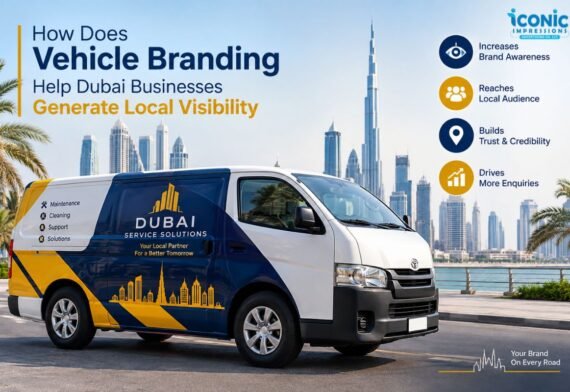
- Why fleet branding matters for Dubai businesses?
- How vehicle branding actually works?
- Materials and finishes: what to choose
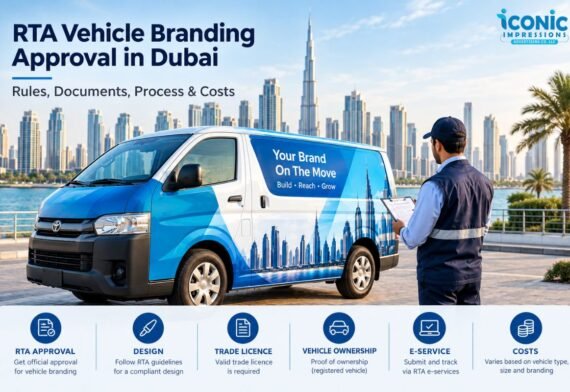
- RTA rules and compliance you can’t skip
- Cost factors that change your budget
- Common mistakes companies make
- How to choose the right vendor?
- Maintenance and lifespan
- Conclusion
- Frequently asked questions
Key takeaways
- Every month one branded vehicle creates several thousand local impressions during its business trips.
- High-quality branding materials are more durable and effective in harsh weather conditions of Dubai.
- Following RTA branding guidelines helps businesses avoid penalties and avoid costs associated with vehicle rebranding.
- Reliable vehicle branding companies guarantee compliance-based designs to minimize time-expensive branding costs.
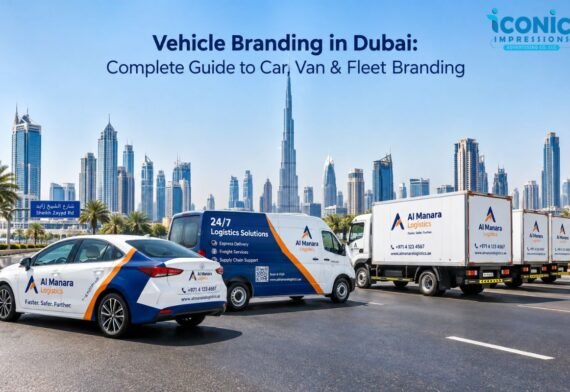
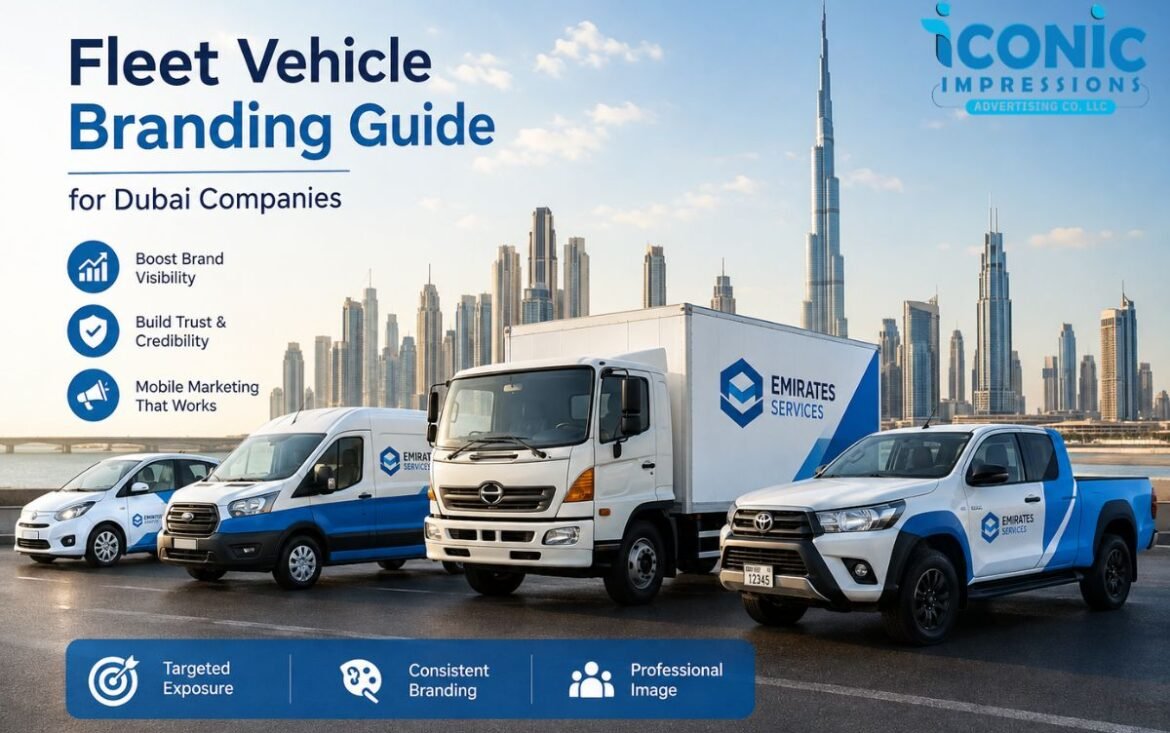
If you’re running a delivery fleet, a service fleet, or even just three or four company cars around Dubai, those vehicles are on the road for hours every day. That’s advertising space you’re already paying for through fuel and maintenance, and most companies don’t use it well. Done properly, vehicle branding in Dubai turns an ordinary van or sedan into something that still works for you while it’s parked outside a client’s building. Here’s how the process actually works, what it costs, what RTA expects, and where companies tend to lose money on it.
Why fleet branding matters for Dubai businesses?
Dubai’s roads stay busy most hours of the day. A branded van stopped at a signal on Sheikh Zayed Road gets seen by hundreds of drivers in a couple of minutes, and unlike a billboard or a social ad, you’re not paying per impression. It’s just sitting there working.
For B2B companies, there’s a second effect that’s easy to miss: it signals legitimacy. A plumbing contractor showing up in a plain white van reads differently than one arriving in a vehicle with a logo, a phone number, and a clear service list. People trust what they can identify.
There’s a practical side too. Fleet branding helps with:
- Faster identification of staff and vehicles on-site
- Less risk of unauthorized vehicle use
- Easier tracking of company vehicles across job sites
- A consistent look wherever the fleet shows up
How vehicle branding actually works?
The process is more involved than most people assume. It isn’t a logo slapped on a door.
- Design and template mapping- The designer works off actual vehicle dimensions, not a generic template, since panel curves, door handles, and mirrors all change where graphics can sit without warping.
- Printing- Document files utilized with solvent and eco-solvent inks suited for use outdoors are sent to large-format printers for printing.
- Lamination- A layer of protection is applied over the print to prevent UV fading, especially considering how much the vehicle is exposed to the sun for a large part of the year.
- Application- Professionals heat the vinyl and stretch it around the curves before squeezing out the air. This step can determine if the wrap is still free of imperfections after three years or if it starts peeling within a matter of months.
Therefore, a rushed install is the most common reason branded vehicles look bad within a year. Ask any vendor how long their team actually spends per vehicle. A full van wrap done properly takes six to ten hours, not two.
Materials and finishes: what to choose
| Material | Best For | Typical Lifespan | Notes |
| Cast vinyl | Full wraps, curved panels | 5–7 years | Conforms well, higher cost, resists shrinking |
| Calendared vinyl | Flat panels, partial branding | 2–3 years | Cheaper, struggles on complex curves |
| Perforated window film | Rear/side windows | 3–4 years | Visible from inside, blocks the view from outside |
| Painted branding | Long-term fleets (10+ years) | 8–10 years | Costs more upfront, holds up best in extreme heat |
Most companies default to vinyl because it’s reversible, which matters if a fleet ever gets resold or rebranded. Painted branding makes more sense for government contracts or fleets that won’t change hands for a decade.
Moreover, one thing people don’t think about: matte versus gloss laminate changes how much heat the panel absorbs. Darker gloss wraps can run a few degrees hotter in direct summer sun than matte finishes do. Small factor, but worth knowing if a fleet sits outdoors all day.
RTA rules and compliance you can’t skip
Dubai’s Roads and Transport Authority has specific restrictions on vehicle advertising, and they catch a lot of first-time fleet owners off guard.
- Windshield advertising is limited to a small strip, not full coverage
- Side and rear windows have coverage limits to preserve visibility for the driver
- Taxis and government vehicles have their own separate branding rules
- Content can’t be offensive or misleading
Furthermore, get this wrong and you’re looking at fines, or worse, being told to strip the branding off and start over. This is one place where cutting corners on a vendor’s knowledge costs more than it saves. A vendor who does regular fleet work in the UAE already knows these limits. They shouldn’t need to look them up mid-project.
Cost factors that change your budget
Pricing for vehicle branding in Dubai varies more than most people expect, and it’s almost never a flat per-vehicle rate. What moves the number:
- Vehicle size (a sedan costs less than a delivery van or truck)
- Coverage type: partial branding versus a full wrap
- Material grade, since cast vinyl runs more than calendared vinyl
- Design complexity, with custom illustration costing more than a template layout
- Fleet size, where most vendors give per-unit discounts past five or ten vehicles
A sedan with a logo and phone number is a completely different budget conversation than a full wrap across ten delivery trucks. It’s reasonable to get quotes from more than one vehicle branding company in Dubai before you commit. Pricing isn’t standardized across vendors the way it is for some other services.
Common mistakes companies make
- Skipping the site visit- Some vendors quote off photos alone, and that leads to measurement errors and reprints.
- Going cheap on vinyl for a full wrap- Calendared vinyl on curved panels tends to lift within a year once Dubai’s heat cycles get to it.
- Cramming the design- Logo, tagline, phone number, list of service and social handles into one van panel results in no information that could be seen while the car is in motion. A better solution is to have two or three important elements only, like logo, one line telling what you do and phone number.
- Skipping maintenance- Automatic car washes with rigid brushes damage vinyl edges over time. Use a hand wash or soft brush wash to keep the wrap looking better for longer.
- Not budgeting for reprints- Fleets rebrand every few years as logos change or numbers get updated. A vendor who keeps your design files on file makes the second round cheaper.
How to choose the right vendor?
Search “vehicle branding near me” and you’ll get a long list, but not everyone on it handles fleet-scale work well. Before signing anything, check a few things:
- Ask to see photos from completed fleet projects, not just single vehicles
- Confirm whether RTA compliance is part of the service or something you have to sort out yourself
- Ask about warranty terms on both the vinyl and the install
- Check if they do on-site installation for larger fleets. Driving ten vehicles to a workshop isn’t always realistic
Iconic Impressions Advertising has worked on fleet and vehicle branding projects across Dubai, handling design, printing, and installation as one process rather than splitting it across separate vendors. That tends to cut down on the miscommunication that happens when timelines and specs pass through too many hands.
Maintenance and lifespan
Once a fleet is branded, upkeep stays fairly low, but it isn’t zero.
- Hand wash where you can, and skip high-pressure automatic washes with brushes
- Keep vehicles out of direct sun when possible; shade adds real years to a wrap
- Fix small tears or lifting edges right away. Moisture and dust get underneath and the damage spreads fast
- Reapply protective laminate on high-mileage vehicles every few years if the wrap is staying on long-term
Therefore, a well-kept wrap on cast vinyl still looks presentable at five years. Neglected wraps on cheaper material can start peeling in twelve to eighteen months.
Conclusion
Fleet branding earns its money every moment a vehicle is on the road, not only when it’s first applied. Achieving success depends on the careful selection of materials according to Dubai’s weather, adhering to the RTA’s advertising regulations, and finding brand installers that are experienced in fleet jobs. Companies that treat fleet branding as a one-time expense then find themselves needing to reprint sooner than expected.
Are you planning to implement a new fleet program? Iconic Impressions Advertising can advise on the design and compliance specifics according to your vehicles and routes.
Frequently asked questions
Cast vinyl typically holds up five to seven years with proper care. Calendared vinyl and lower-grade materials usually start fading or lifting after two to three.
Coverage and content have to follow RTA guidelines, especially on windows and windshields. Most reputable vendors handle this check as part of the job.
A full wrap covers the whole body. Partial branding covers select panels, usually doors and rear panels, with a logo and contact details.
It depends on vehicle size, material, and design complexity. Sedans with partial branding cost less than vans or trucks with full wraps, and bulk fleet pricing usually brings the per-unit rate down.
Vinyl applied and removed properly by trained installers generally leaves the paint fine. DIY removal or cheap vinyl can leave adhesive residue or minor paint issues behind.
Look at photos from completed fleet projects, confirm they handle RTA compliance, and ask about installation warranty. Vendors with real multi-vehicle experience tend to manage timelines better.
Perforated window film is built to be visible from inside while showing graphics on the outside, so drivers stay compliant without losing visibility.
Most companies do it every three to five years, either because the material’s worn out or because logos, numbers, or services have changed.
Cooler months, November through March, make installation easier since extreme heat can affect how the vinyl cures. That said, installers with climate-controlled bays work year-round.
Depends on the lease. Some leasing companies restrict permanent modifications, so it’s worth checking their vinyl wrap policy before booking. Most wraps come off clean anyway.