
-
Iconic Impressions Advertising
- August 13, 2026
- No Comments
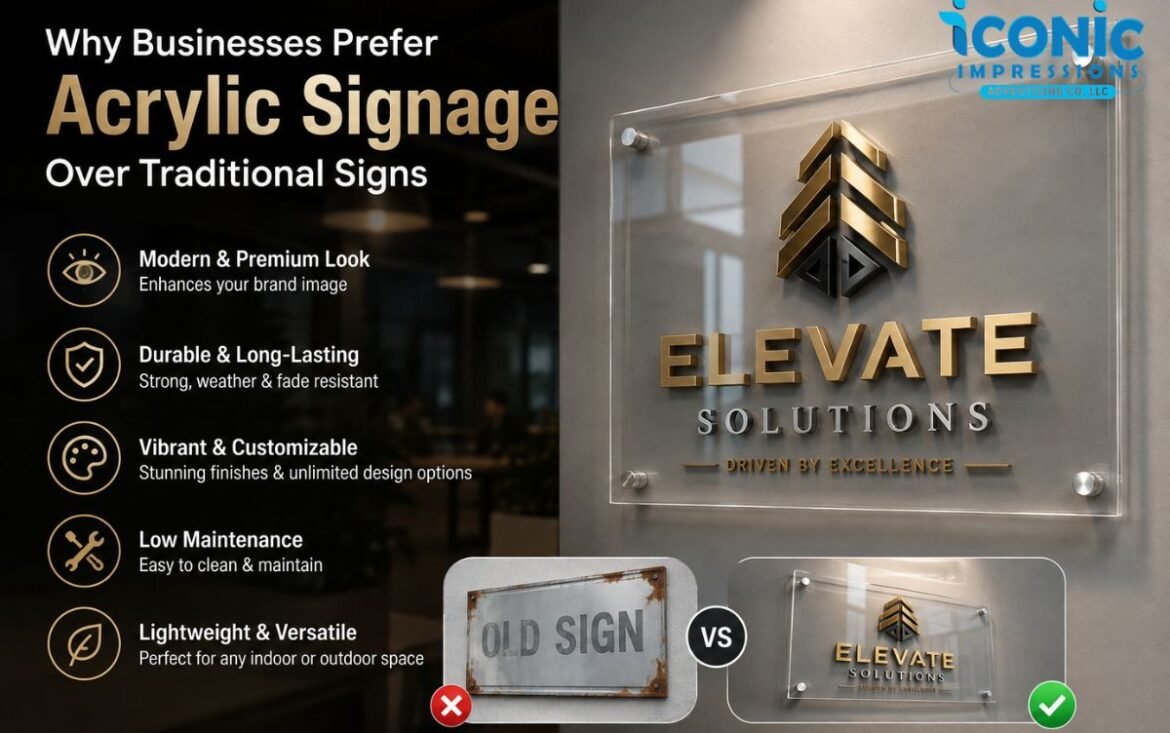
Why Businesses Prefer Acrylic Signage Over Traditional Signs
Table of Contents
- Key Takeaways
- What makes acrylic different from traditional signage materials?
- The practical case for acrylic indoor signs
- Acrylic vs traditional signs: A side-by-side look
- Where do bespoke acrylic product suppliers add value?
- Display stands, trays, and other acrylic formats businesses rely on
- Common mistakes businesses make when switching to acrylic
- How to choose the right supplier?
- Final thoughts
- Frequently asked questions
Key Takeaways
- Acrylic is more resistant to weather conditions and ultraviolet rays in Dubai than regular signage materials.
- With their ability not to warp, fade, or be damaged, businesses save on maintenance.
- With acrylic products, custom-created shapes, lighting, and high-quality designs can be done with great ease.
- Reliable manufacturers guarantee proper craftsmanship, durability, and long-term effectiveness in their use.
Walk into any mall, showroom, or office lobby in Dubai these days, and the wooden signage has mostly disappeared. So has the painted board. What’s replaced them is acrylic, and it’s not a fluke. It comes down to climate, cost, and how businesses want their branding to hold up years after installation, not just on the day it goes up.
Wood, MDF, and painted metal are not what this climate is made for. They will bend, crack, and discolor sooner than most business people expect. Acrylic does not fall victim to most of these issues, which is partially the reason why acrylic signs in Dubai are so common in retail, hotel, and corporate places.
Let’s take a closer look at what is the reason behind this trend, what are the benefits of acrylic in everyday life, and some common mistakes that companies tend to make when switching materials.
What makes acrylic different from traditional signage materials?
Acrylic is a type of solid plastic that is made out of polymethyl methacrylate (PMMA). It does not absorb moisture in the same way that wood or medium density fiberboard (MDF) would. It does not rust or corrode like painted metal either. In addition, it maintains its shape under weight and pressure in a way that foam boards cannot do.
It behaves differently when it comes to colors and light. It can be cut using a laser, stacked on top of each other for depth, and backlit for light effects that wood and metal would not be able to produce without additional hardware. This gives the businesses the advantage to use their signage not just for function but also for the purposes of design.
Nevertheless, the finish is very important as well. Acrylic can be polished to shine like glass or left cloudy for a more gentle look but the edges of the letters or logos are better cut compared to the other materials.
The practical case for acrylic indoor signs
Indoor climate control in Dubai is strong, but it’s not uniform. Signage near entrances, glass facades, or poorly insulated corners still takes on heat and light exposure that would wear down weaker materials within a year or two.
Therefore, this is precisely where acrylic indoor signs in Dubai get their name. This material doesn’t turn yellow quickly when exposed to indoor lighting, doesn’t warp due to the temperature changes between indoor air conditioning and outdoor heat when being by entryways, and gets rid of the fine dust that collects in porous materials over time.
One of our retail clients used to have to change their wooden directional signage every year and a half because of warping near their reception area. Later, when they started using acrylic for their signage, it stayed in its original shape and color for 3 years and showed no signs of wear.
Acrylic vs traditional signs: A side-by-side look
| Factor | Acrylic Signage | Traditional Signage (Wood/Metal/Foam) |
| Moisture resistance | High: doesn’t absorb water | Low to moderate: prone to swelling or rust |
| UV/fade resistance | Strong, especially with UV-coated grades | Weak, fades or discolors within 1 to 2 years |
| Weight | Lightweight, easier to install | Heavier, often needs stronger mounting |
| Custom shapes | Easily laser-cut into precise designs | Limited by cutting tools and material rigidity |
| Maintenance | Low, occasional wipe-down | Higher, needs repainting, sealing, or replacement |
| Lifespan (indoor use) | 5 to 8 years average | 2 to 4 years average |
| Cost over time | Higher upfront, lower long-term cost | Lower upfront, higher replacement cost |
Acrylic material can be more expensive than regular foam board or regular wood material in the beginning. Nevertheless, once you also take into account replacement schedules, it appears that the majority of the organizations can recover their expenses for 2-3 years.
Where do bespoke acrylic product suppliers add value?
The benefits of acrylic can only be realized through its proper processing, which comprehends such aspects as the edges quality, acrylic thickness compliance with the usage, and the selection of the fixation elements depending on the sign weight and location. Otherwise, many advantages will be lost.
This is where cooperation with good Bespoke Acrylic Products Suppliers in Dubai influences success. Suppliers that possess knowledge of the local situation will be able to suggest the right type of acrylic – whether cast or extruded- in accordance with the location and the amount of light. Cast acrylic is costly but has outstanding anti-yellowing features, making it the best choice for implementation in areas near the windows or strong indoor light.
If the supplier has in-house capabilities, the issues with designs can be identified and corrected before the beginning of production stages. Such issues include, for example, the points of fixing that won’t support the weight of the sign. That kind of oversight is what saves businesses from an expensive reprint.
Display stands, trays, and other acrylic formats businesses rely on
Signage isn’t the only place acrylic shows up. Retail counters, hotel lobbies, and corporate offices lean on it for functional display pieces too.
Display stands are a frequent request from retail and exhibition clients. Acrylic display stands suppliers in Dubai typically offer modular pieces, risers, brochure holders, and product stands that can be rearranged for different layouts without buying new pieces every time. Because acrylic is transparent, the product stays the visual focus instead of competing with a bulky stand.
Trays work on the same logic. Acrylic trays suppliers in Dubai serve hospitality venues, retail counters, and offices that want something more durable and presentable than plastic or melamine. Acrylic trays don’t stain easily, clean up fast, and keep their polished look far longer than cheaper materials.
A few formats businesses order regularly:
- Wall-mounted directory and wayfinding signs
- Illuminated reception signage
- Product display risers and stands
- Menu holders and presentation trays
- Branded counter dividers
Common mistakes businesses make when switching to acrylic
- Choosing thickness based on price alone- Thin acrylic, under 3mm, flexes and can crack under mounting pressure. For wall signage, 5mm to 10mm is usually the safer range depending on size.
- Ignoring UV grade for sunlit areas- Standard acrylic can still yellow near windows or skylights. UV-resistant grades cost more, but they avoid premature discoloration.
- Skipping proper edge finishing- Rough or unpolished edges chip more easily and look unfinished, especially on display stands that get handled a lot by staff or customers.
- Assuming every supplier fabricates the same way- Laser cutting quality varies a lot between suppliers. Poorly calibrated equipment leaves burn marks or uneven edges that are hard to fix after the fact.
- How to choose the right supplier?
A few questions worth asking before committing to one:
- Do they fabricate in-house, or outsource production?
- Can they show samples of previous signage or display work?
- Do they offer both cast and extruded acrylic, and can they explain when to use each?
- What’s their typical turnaround time on custom orders?
- Do they handle installation, or only fabrication?
A supplier who answers these directly, without vague reassurance, is usually one worth trusting with a bigger order.
Final thoughts
The move toward acrylic comes down to a climate that wears down traditional materials faster than most businesses plan for, and a material that gives more design flexibility for roughly the same long-term cost.
If you’re planning signage, display stands, or presentation trays for your business, an experienced fabricator is the difference between a sign that lasts and one you’re replacing within the year. Iconic Impressions Advertising has handled exactly this kind of work across Dubai’s retail, hospitality, and corporate spaces, and can walk you through material selection, design, and installation from start to finish.
Frequently asked questions
The average lifespan of acrylic indoor signage is 5-8 years with very little maintenance, depending on the level of lighting exposure and the grade of acrylic used.
Acrylic is a bit more expensive upfront, but is typically more cost-effective in the long run due to reduced maintenance costs and longer use life.
Yes. It’s one of the most used materials for backlit and LED-edge-lit signage due to its equal light diffusion.
Cast acrylic is more durable and UV resistant, but is more expensive. Extruded acrylic is more affordable, but will yellow faster.
It can, but when not handled carefully, the risk is reduced by the use of scratch-resistant coatings and proper cleaning.
Yes, with UV-stabilised grades; however, the longest duration and least maintenance is still achieved when used indoors.
Use a soft microfiber cloth and mild soap and water. Avoid ammonia cleaners; they tend to crack over time.
Most suppliers provide branding, custom sizing, shapes, and finishes, particularly for retail or exhibition applications.