
-
Iconic Impressions Advertising
- August 18, 2026
- No Comments
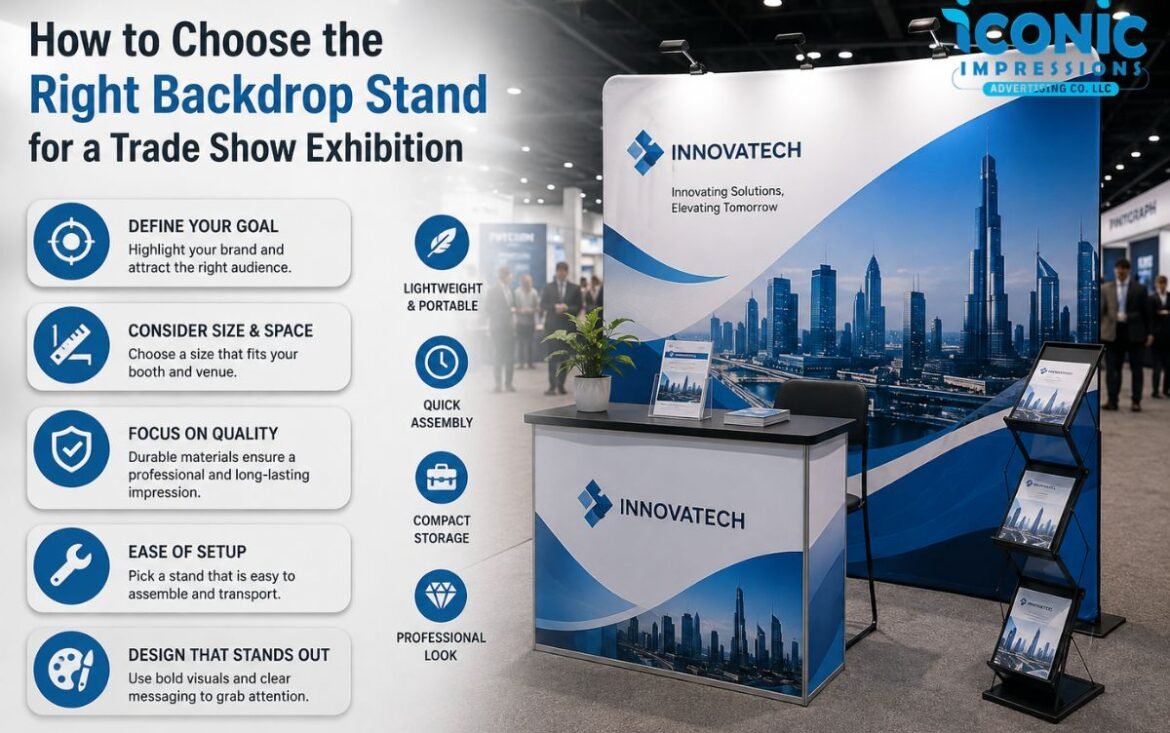
How to Choose the Right Backdrop Stand for a Trade Show Exhibition
Table of Contents
- Key takeaways
- Why does your backdrop stand decision matter?
- Types of backdrop stands you’ll come across
- Adjustable vs fixed stands: A side-by-side look
- Key factors to check before you buy
- Material and build quality checks
- Mistakes exhibitors keep making
- How to pick the right supplier?
- Expert tips from the exhibition floor
- Final thoughts
- Frequently asked questions
Choosing the right trade show backdrop stand boils down to three factors: frequency of reuse; the sizes required by different booths; and the extra weight due to graphics and lighting.
When companies exhibit several times throughout the year, an adjustable aluminium backdrop stand is usually preferred over a fixed-size frame. An adjustable backdrop stand can provide the necessary size for an exhibit space, requires fewer shipping pieces, and is much more durable than cheaper alternatives. Useful features include:
- Adjustable telescopic legs or segments for different heights and widths
- Weight capacity exceeding the heaviest graphic to be used
- Easy construction of the backdrop stand without the use of any tools, since most exhibitors assemble their displays at the show.
If you are exhibiting in the UAE, partnering with an established Dubai supplier of backdrop stands saves you the hassle of long shipping and ensures that you have the appropriate stock for the local venue.
Key takeaways
- Backdrop stands that can be adjusted should be able to accommodate different heights, widths, and weights without the need for any extra equipment.
- Aluminum tube and clamp systems are utilized by businesses that are attending several trade exhibitions throughout the year.
- Dubai’s hectic schedule of exhibitions means that getting a backdrop stand that can be re-used over time is a worthy investment.
- Reliable suppliers assist with installation, parts replacement, and information about load limits.
Why does your backdrop stand decision matter?
A backdrop stand connects everything at your exhibition space. Your branding is extended from it, and your lighting is placed on it as well. In addition, the way it appears from far away is highly significant because it creates the first impression even before any communication occurs.
However, the designers of exhibition booths often mention the “three-second read” principle, which implies that the decision about whether to visit your booth or not is made at first sight. The visual clarity and simplicity of the booth perception from a distance influence the opportunity to attract visitors to your exhibit.
In Dubai, this issue becomes especially important. The emirate will host 74 exhibitions in the period between 2026 and 2027 and, for instance, GITEX Global will attract more than 200,000 visitors and 6,800 exhibitors from 183 countries. Another exhibition, Gulfood, will be attended by another 97,000 trade visitors and some 5,000 exhibitors.
Types of backdrop stands you’ll come across
Most backdrop stands sold for exhibitions fall into a handful of categories, and each suits a different exhibiting style.
- Tube-and-clamp (pop-up) frames- These are the most common. They fold flat for transport, assemble without tools, and work well for companies that need a reliable, no-fuss setup show after show.
- Telescopic tension fabric stands- It stretches printed fabric over an adjustable frame. They give a clean, wrinkle-free finish and pack into a single bag, which matters when you’re flying graphics into a show rather than trucking them.
- Modular aluminium wall systems- These are built from interlocking panels and bars. They’re the most flexible option here, and about as close as you get to a true adjustable backdrop stand Dubai exhibitors use when booth sizes change from one show to the next.
- Fixed banner stands- This is the simplest and cheapest, but they only suit one graphic size and don’t scale if your booth footprint changes.
If your brand shows up at varied booth sizes across different halls, a modular or telescopic system will serve you longer than a fixed frame ever will.
Adjustable vs fixed stands: A side-by-side look
| Factor | Adjustable Stand | Fixed Stand |
|---|---|---|
| Booth Size Flexibility | Adapts to multiple widths and heights | Locked to one graphic size |
| Reusability Across Shows | High: works for 3m, 6m, or island booths | Low: needs replacement if layout changes |
| Setup Time | Slightly longer, tool-free | Fastest setup |
| Upfront Cost | Higher initial investment | Lower initial cost |
| Cost Over 3+ Shows | Often cheaper overall | Adds up with repeat purchases |
| Best Suited For | Frequent exhibitors, agencies, multi-brand booths | One-off events, small local pop-ups |
Furthermore, if you’re exhibiting once and don’t plan to repeat it, a fixed stand is fine, honestly. Anyone booking more than one or two events a year tends to find that an adjustable backdrop stand Dubai suppliers stock works out cheaper per show once you factor in storage and replacement costs.
Key factors to check before you buy
Before placing an order, run through what actually determines how a stand performs on the show floor.
- Weight capacity-Confirm the frame can hold your graphic plus any lighting, TV mounts, or shelving you’re planning to attach, not just the printed panel alone.
- Portability-Check the packed dimensions and weight if you’re flying graphics to another emirate or country for a show.
- Assembly time- Ask for a real setup time, not a marketing estimate. Booths get built under time pressure the night before opening more often than anyone likes to admit.
- Venue compatibility- Dubai World Trade Centre and other major halls have height restrictions and rigging rules that vary by hall. Confirm your stand fits before you print graphics.
- Warranty and spare parts- Connectors and clamps wear out. A supplier who stocks replacements saves you from scrapping an otherwise good frame over one broken part.
A reliable backdrop stand supplier in Dubai will walk through these points with you based on frames they’ve actually installed in the halls you’re booking, not just a specific sheet.
Material and build quality checks
Not all aluminium is equal, and this is where a lot of exhibitors get caught out. Cheaper frames use thin-walled tubing that flexes under load and loosens after a few setups. Better systems use anodised aluminium with reinforced joints, which holds tension and resists denting during transport.
Fabric graphics matter here too. A stretch fabric cut slightly undersized will pucker at the seams no matter how good the frame is. If you’re sourcing trade show display stands in Dubai, ask whether the supplier prints in-house or outsources the fabric. In-house printing usually means tighter tolerances between frame and fabric.
Connectors are worth checking physically, not just on paper. Snap-fit clamps are faster to assemble but wear faster with repeat use. Threaded connectors take a bit longer to set up but hold their tension for years.
Mistakes exhibitors keep making
A few of these come up on almost every install I’ve seen go wrong.
- Buying a fixed stand for a brand that exhibits regularly- Looks like savings on paper. After the second or third show, once you’ve paid for a new frame or new graphics to match a different booth size, the fixed option usually costs more.
- Ignoring the venue’s rigging rules- Some halls in Dubai cap structure height or restrict what can be hung from the ceiling grid versus what needs to stand freely. Find this out before you design your graphics, not after.
- Underestimating shipping damage risk- A stand that survives one local show can arrive bent after international freight if the case isn’t rated for it.
- Choosing display stands suppliers in Dubai on price alone- The cheapest quote often leaves out on-site support, spare connectors, or a replacement guarantee, and those are exactly the things that matter once you’re standing in a half-built booth two hours before doors open.
How to pick the right supplier?
This is where most of the actual risk sits. A good frame from a poor supplier is still a poor experience.
Ask a shortlisted backdrop stand supplier in Dubai these questions directly:
- Do you offer on-site setup or supervised installation, or is it delivery only?
- What happens if a connector or panel breaks during the show?
- Can you show me a stand you’ve installed in the specific hall I’m booking?
- What’s your turnaround time if I need a replacement graphic printed locally?
Local sourcing has a practical advantage that’s easy to overlook: a Dubai-based supplier can usually get a replacement part to your booth within hours, not days. That alone has saved more than one exhibitor’s opening morning.
Therefore, among the display stands suppliers in Dubai worth comparing, look for ones with an actual production facility rather than a reseller shipping everything in from overseas. Local production means faster turnaround if a graphic needs a last-minute reprint.
Expert tips from the exhibition floor
A few things worth telling any first-time exhibitor before they commit to a stand.
Order your frame at least three weeks out, not three days. Print files need to match the exact frame dimensions, and rush fees for both frame and fabric add up fast during peak months like September and November, when Dubai’s show calendar gets busy.
Test-assemble the stand once before the event, ideally in the space where your team will actually be building it. A frame that goes together fine in a warehouse can behave differently on carpeted show floor tiles.
Moreover, keep a small spares kit on hand: extra connectors, a rubber mallet, gaffer tape. Even well-built trade show display stands in Dubai occasionally need a five-minute fix mid-setup, and having the parts with you beats waiting on a supplier callout.
Final thoughts
A backdrop stand is more than looks. It’s primarily a reliability thing. Consider how frequently you will use it, its ease of use, and whether the vendor can assist you in the event of difficulties.
For your upcoming exhibition, you can rely on Iconic Impressions Advertising to assist Dubai exhibitors in designing their backdrop stands, graphics, and complete exhibition booths. They can also assist you in selecting one that will match your venue and budget.
Frequently asked questions
The majority of 3m x 3m booths have a width of 2.4m to 3m. Please ensure that you check with the organiser for the exact booth size prior to ordering, as this varies from hall to hall.
Yes, upfront. Generally, adjustable stands are less expensive when used by exhibitors who attend multiple or double shows annually, because the frame is not being replaced every year.
Most of the tool-less frames can be done in 20 to 40 minutes with two people. The more panels and the more intricate the graphics, the longer it may take to do modular wall systems.
Many can, but only if they have been rated for that additional capacity. When mounting screens or shelves, please check the weight capacity with your supplier beforehand.
Reinforced joints on anodised aluminium are best. Untreated thinner aluminium is not very durable and will loosen and dent after a few setups and teardowns.
There are height and rigging limitations at some venues, such as part of Dubai World Trade Centre. Make sure your design is correct with the organiser and supplier before completing your purchase.
Rental is typically the best choice for one show. When shopping for a stand for re-exhibit in the next year, the adjustable stand is usually the more cost-effective option.
During the show, ask what comes with the frame beyond the actual frame itself: setup support, spare parts, warranty and turnaround time for reprints, fix-ups, etc.
Failure to provide proper cases. Ensure that you have a rated stand sent in a flight case and allow for additional time for customs clearance prior to show dates.
Yes, in fact, most modular and tension fabric systems are created for this very purpose. The only thing that changes is the printed panel; the frame is used for several events.