
-
Iconic Impressions Advertising
- September 17, 2026
- No Comments
Table of Contents
- Key takeaways
- Why does stainless steel work for Dubai’s climate?
- Common types of stainless steel signage
- Popular finishes and what they communicate
- Where do businesses use it most?
- Key benefits of stainless steel signage
- Signage vs other metal options
- Cost and maintenance realities
- Choosing the right fabrication partner
- Bottom line
- Frequently asked questions
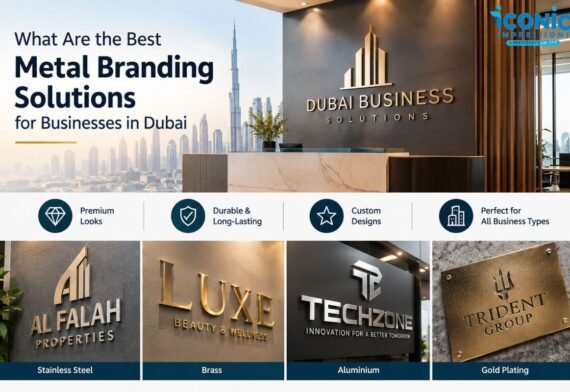
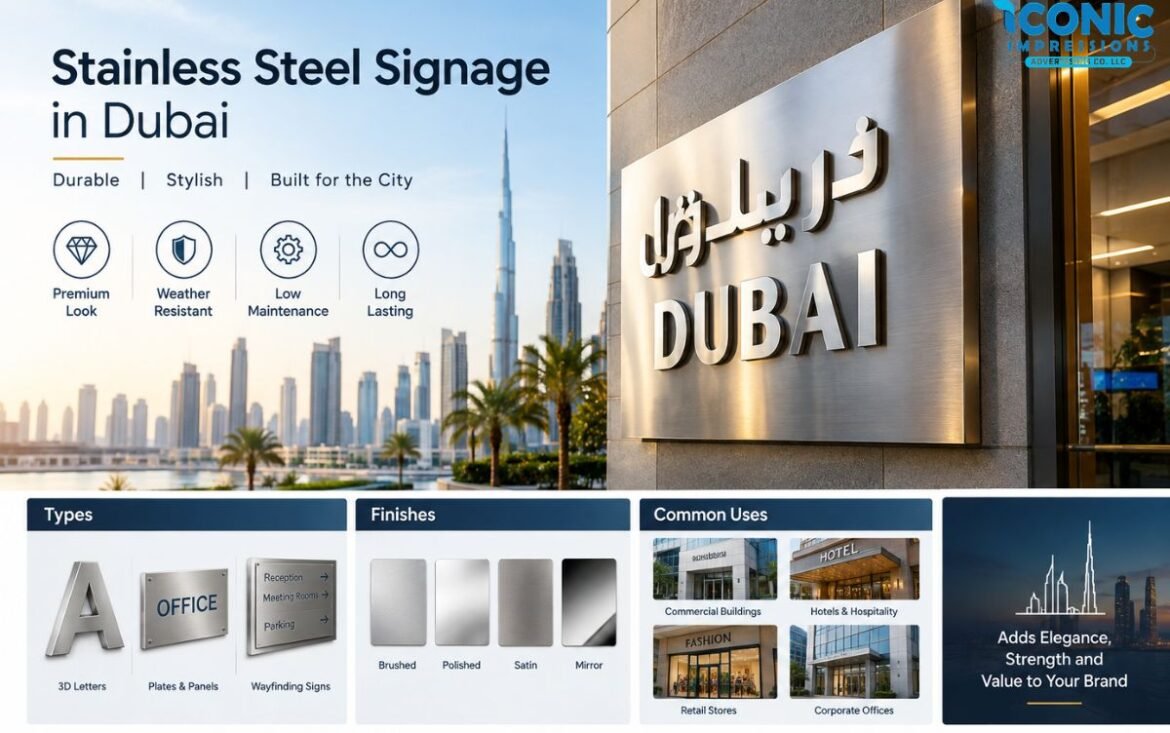
Stainless steel signs have become a go-to for many businesses in Dubai, as they can withstand the test of time and also look great. Due to the sunny and humid weather, steel boards usually survive here, but acrylic and PVC boards don’t. The following guide discusses the various types, style options, advantages, and uses in order for you to know what will work best for your building, finance, and branding needs before you start collaborating with your new supplier.
Key takeaways
- Unlike most metals, stainless steel is resistant to rust as well as the damaging effects of salt air and UV light.
- In the case of indoor signage, using grade 304 is just enough, but for outdoor use, due to the severe conditions that would be encountered, grade 316 will be used.
- Brushed, mirror, PVD gold, and powder-coated finishes help achieve various effects.
- Reliable metal fabrication services in Dubai fix issues of warping, welding marks, and uneven surfaces.
Why does stainless steel work for Dubai’s climate?
Dubai is not a city that is generous with building materials. The heat regularly reaches 45°C in the summer, and humidity levels are often high by the coast, and sand in the air acts like a slow sandblaster on everything softer than metal. Painted aluminum chips. Acrylic yellows and warps after extended exposure to the sun – wood can’t compete!
However, stainless steel is able to handle it all. The alloy’s chromium is oxidized to a passive layer that is self-repairing with simple maintenance, so a sign placed five years ago on a Sheikh Zayed Road storefront can still look good with minimal care. It is this durability that has caused a major paradigm shift in the use of metal branding in Dubai over the past decade, particularly in retail facades, hotel signage, and corporate reception walls.
Common types of stainless steel signage
Not all stainless signs are created equal, and the process used in the making of a sign is more important than the average consumer would think.
- Laser Cut Letters & Logos: Individual letters or logo shapes are cut from a steel sheet and mounted flush, or raised on standoffs or backlit. When it comes to fine detailing, such as intricate Arabic calligraphy, a laser cutting services Dubai provider must have tight tolerances.
- Panels to be etched or engraved: The recessed text or patterns are formed on a flat panel by chemical etching or mechanical engraving and are usually filled with paint or epoxy to create a contrast. Typical place-marker signs and plaques.
- Fabricated 3D letters: Constructed from folded or welded steel to a depth to provide a premium dimensional appearance typical of hotel entries and corporate head offices.
- Composite panel signage: A stainless steel face with a light core, which is used when solid steel is too heavy for the mounting structure.
Popular finishes and what they communicate
The finish does as much visual work as the shape of the letters.
- Brushed (satin) finish: A soft, linear finish that minimizes fingerprints and slight scratches. Most use it on commercial signs with no special effort for its appearance because it is a clean look without effort.
- Mirror polish: A finish that reflects light significantly, yet reveals all the smudges. More appropriate for indoor uses or low-touch surfaces.
- PVD (Physical Vapor Deposition) coating: gives the steel a gold, rose gold, black, or bronze appearance. It has now become the brand of choice for luxury retail and F&B brands in Dubai Mall and beyond.
- Powder-coated stainless: A steel type that is coated with a matte or custom colour, allowing its strength to be combined with the colour that best fits the brand’s palette.
Where do businesses use it most?
There are more places than one might think that stainless steel signage is found:
- Shop-front letters and retail storefront branding.
- Statements of hotel and restaurant entrance signage.Signage for entrances to hotels and restaurants.
- Corporate wayfinding logos for office reception.Signage and logos for office reception wayfinding around the corporate office.
- Creating directories and floor plaques
- Industrial and warehouse identification signs
- Monument and pylon signs at business parks are located outside.
Therefore, with each of these, there is a different level of exposure, and that’s why you need to select your grade first, then your finish grades.
Key benefits of stainless steel signage
- Long-term durability: Remains corrosion- and UV-resistant and physically durable for a longer time than acrylic, PVC, or painted aluminum, particularly in Dubai’s heat and coastal humidity.
- Low maintenance requirement: Clean occasionally using a mild, non-abrasive cleaner. No repainting and no panels replaced in the 3- or 4-year cycle.
- Premium look: Finishes such as mirror polish and PVD gold instantly elevate brand perception, especially in retail and hospitality.
- Design flexibility: Works on flat panels, 3D letters, backlit displays, and fine laser-cut detailing such as Arabic calligraphy, at tight tolerances.
- Resisting wind and traffic: Will not warp like thinner or lighter materials when exposed to wind or heavy traffic.
- Greater ROI over time: The initial investment is higher, but cheaper alternatives have a 15-20 year lifespan, making the TCO lower.
- Fire and heat resistance: Withstands Dubai’s extreme summer weather without softening or warping, as plastics would.
Signage vs other metal options
| Factor | Stainless Steel | Aluminum | Brass/Copper |
| Corrosion resistance | Excellent | Good | Moderate (patinas over time) |
| Weight | Heavier | Lightweight | Heavy |
| Typical use | Exterior, high-traffic, premium branding | Budget exterior signage, lightweight panels | Heritage or boutique branding |
| Maintenance | Low | Low | Higher (needs polishing to prevent tarnish) |
| Relative cost | Mid to high | Low to mid | High |
However, aluminum is lighter and cheaper, which makes sense for temporary or budget-conscious signage. But for anything meant to represent a brand for a decade or more, stainless steel’s strength-to-maintenance ratio usually wins, particularly when it’s paired with precise metal fabrication in Dubai that keeps edges clean and welds invisible.
Cost and maintenance realities
Stainless steel signage costs more upfront than acrylic or PVC, typically 20% to 60% more depending on thickness, finish, and letter complexity. That premium buys longevity. Most well-fabricated stainless signs need nothing beyond an occasional wipe with a mild cleaner and warm water. Skip chloride-based cleaning products near coastal installations; they can accelerate pitting even on 316-grade steel over the years.
Moreover, one thing buyers tend to overlook is thickness. Sheets under 1.5mm can look thin and flex visibly in wind-prone spots, while 2mm to 3mm sheets hold their shape and read as more substantial from a distance.
Choosing the right fabrication partner
The finish and the design concept only matter if the fabrication itself is clean. Poor welding shows as discoloration around joints. Inconsistent brushing creates visible seams between panels. Misaligned laser cuts ruin fine typography, particularly in Arabic script, where stroke width consistency is critical to legibility.
Iconic Impressions Advertising builds its signage work around this level of precision, treating each project as a fabrication problem first and a design problem second. That order matters. A beautifully rendered concept doesn’t count for much if the shop producing it can’t hold tolerances on a laser-cut letter or match a brushed finish across multiple panels. Anyone evaluating metal fabrication services in Dubai should ask to see finished installations in person, not just renders. Photos rarely reveal weld quality or finish consistency.
For businesses juggling multiple locations, or a rebrand across several outlets, working with a single provider like Iconic Impressions Advertising for both design and fabrication also avoids the color and finish mismatches that happen when different shops interpret the same spec sheet differently.
Bottom line
Stainless steel signage earns its higher price through resistance to Dubai’s heat, humidity, and salt air, plus a finish quality acrylic and painted metal simply can’t match over time. The right choice comes down to matching grade, thickness, and finish to where the sign will actually live, whether that’s a shaded reception wall or a sea-facing storefront.
If you’re planning a signage project and want fabrication that holds up under close inspection, get a site assessment and finish sample from a specialist before you commit to a design.
Frequently asked questions
Grade 316 is recommended for coastal or high-humidity areas because it resists chloride-induced corrosion better than 304, which suits most standard outdoor locations.
Well-fabricated stainless steel signage typically lasts 15 to 20 years outdoors with minimal maintenance, assuming correct grade selection and proper installation.
Yes, usually 20% to 60% more upfront, but lower maintenance and a longer lifespan often make it more cost-effective over a 10-year period.
Yes. Laser-cut letters and etched panels are commonly backlit using LED modules, creating a halo or face-lit effect popular for storefronts.
Brushed finish has a matte, linear texture that hides scratches, while mirror finish is highly reflective but shows fingerprints and smudges more easily.
Properly selected and maintained stainless steel resists rust well, though 304-grade signs near the coast may stain faster on the surface than 316-grade.
PVD is a vacuum-based coating process that bonds gold, rose gold, or black color onto stainless steel, giving a premium look without sacrificing durability.
For most commercial applications, 2mm to 3mm balances rigidity and weight; thinner sheets under 1.5mm can flex or warp in exposed locations.
Yes, modern laser cutting achieves the fine stroke widths Arabic typography requires, though it takes a fabricator experienced with the script’s specific curves.
Wipe periodically with warm water and a mild, non-abrasive cleaner. Avoid chloride-based products near coastal installations to prevent premature pitting.