
-
Iconic Impressions Advertising
- September 5, 2026
- No Comments
Best Uses of Acrylic Products for Events in Dubai UAE
Table of Contents
- Key takeaways
- Why has acrylic become the default material for Dubai Events?
- Acrylic display stands suppliers: what they actually build
- Acrylic trays suppliers: where trays earn their keep
- Acrylic Indoor signs: guiding guests without shouting at them
- Choosing the right bespoke acrylic products suppliers
- Standard vs bespoke acrylic: A side-by-side look
- Mistakes event planners make with Acrylic
- Expert tips from the fabrication floor
- Bottom line
- Frequently asked questions
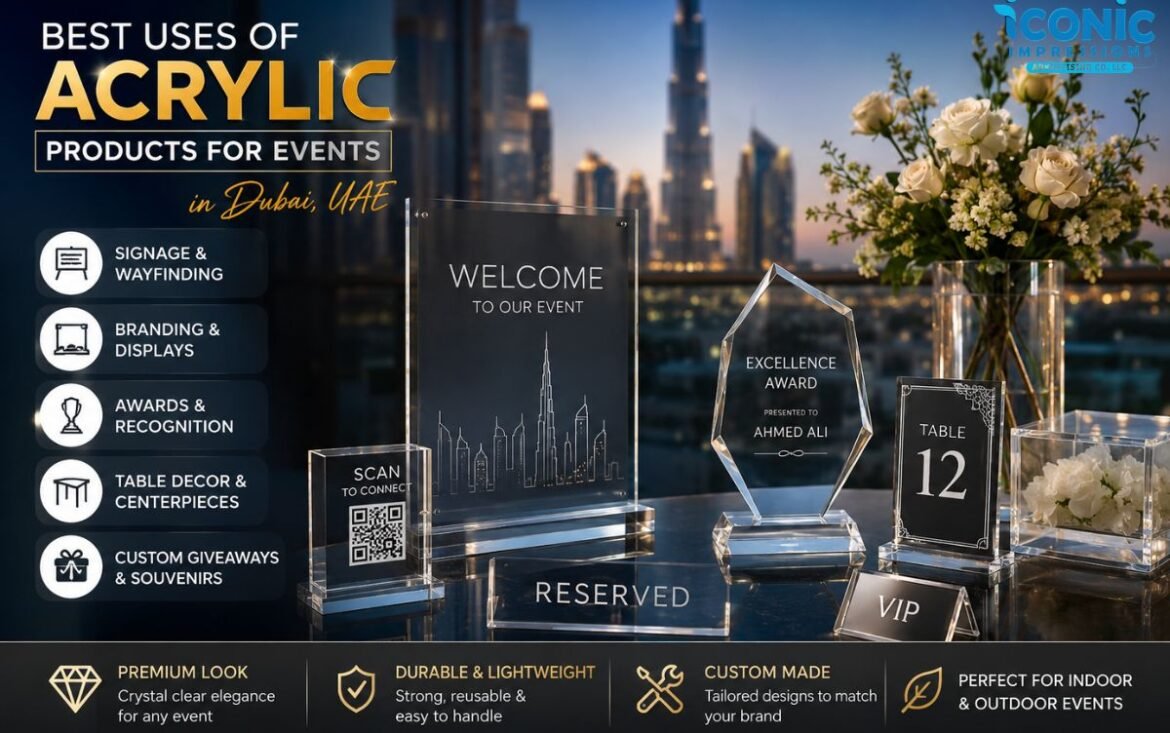
If you’re planning an event in Dubai and need something that has a premium look, withstands the event setup and takedown, and is customizable as per your requirements, then buying products from custom acrylic products suppliers in Dubai is the best and quickest option to consider. Custom acrylic fulfills three types of event requirements; the best acrylic display stands suppliers in Dubai produce stands for showcasing the product and signage for exhibitions and launches, acrylic tray suppliers in Dubai manufacture serving and gifting trays required for hospitality and business events, acrylic indoor signage suppliers in Dubai provide directional signs, welcome boards, and backdrop displays.
According to Mordor Intelligence, exhibitions and conferences contribute up to 32% of the overall market of UAE events. Prices vary depending on the thickness, finishing, and printing technology used, it is generally quoted by suppliers within a day, and production takes less than a week.
Key takeaways
- Customized acrylic products are ideal for events in Dubai due to their ability to handle wear and tear, withstand hot temperatures, and be used many times.
- Usually, suppliers of customized acrylic products in Dubai quickly provide their clients with signs and displays.
- The event management sector of Dubai is experiencing rapid growth, which is why there is a growing demand for branded products.
- Acrylic design mistakes may arise from choosing the wrong thickness, failing to achieve a good finish, or using dimensions that do not fit the stock.
Why has acrylic become the default material for Dubai Events?
Ten years ago, event stands in Dubai were mostly MDF, foam board, or vinyl-wrapped plywood. Acrylic has taken over a large share of that work, and the reason is fairly plain: it holds up better under conditions this city puts materials through.
Dubai’s event calendar is dense. A single week can carry a trade show at DWTC, a product launch in a hotel ballroom, and a wedding at a beach venue, all needing display materials that survive travel, air conditioning swings, and staff moving fast during setup. Acrylic holds its shape in heat better than most plastics, doesn’t warp the way MDF does when it picks up ambient moisture, and takes a printed or engraved finish that looks close to glass without the weight or the breakage risk.
Moreover, there’s a cost logic behind the shift too. A one-off foam board stand gets binned after the event. A well-made acrylic stand gets reused for the next three activations, which changes the math for brands running recurring campaigns. Iconic Impressions Advertising has seen this directly: clients who used to order disposable printed panels now ask for acrylic versions of the same design, because the unit cost evens out after two or three uses.
Acrylic display stands suppliers: what they actually build
When people say “display stand,” they usually mean one of four things, and it’s worth knowing the difference before you brief a supplier.
- Literature and brochure stands: tiered acrylic holders for flyers, business cards, or menus, common at conferences and retail counters.
- Product risers and podiums: pedestal-style pieces used to lift a product above the display surface, popular in jewellery, cosmetics, and tech launches.
- Freestanding signage stands: L-shaped or A-frame acrylic frames holding printed inserts, used at entrances and registration desks.
- Custom exhibition modules: larger, multi-panel structures built to a booth’s exact footprint, usually the most expensive category.
Furthermore, good acrylic display stands suppliers in Dubai will ask about footfall, lighting, and whether the stand travels between venues before they quote. A stand that only needs to survive one indoor gala has different thickness requirements than one going to three outdoor markets across a season. Most standard stands use 3mm to 5mm cast acrylic; anything load-bearing, like a product riser holding a heavier item, usually needs 8mm or thicker.
First-time clients often assume clear acrylic is the only option. It isn’t. Frosted, mirrored, and tinted finishes all exist, and for brand-heavy stands, a tinted or colour-matched panel often reads better under exhibition lighting than plain clear stock.
Acrylic trays suppliers: where trays earn their keep
Trays are the quieter half of this category, but they show up constantly at Dubai events: corporate gifting tables, hotel amenity trays, dessert and canapé service at galas, and branded welcome kits handed out at conferences.
Acrylic trays suppliers in Dubai generally work with two build methods: laser-cut flat panels bonded at the edges, or heat-bent single-sheet trays with rounded corners. The bent version costs more but looks cleaner and holds up better to repeated washing, which matters if the tray is doing catering duty rather than a one-time gift presentation.
A few practical notes from repeat orders:
| Use Case | Recommended Thickness | Finish |
| One-time gifting tray | 3mm | Printed logo, clear edges |
| Reusable catering tray | 5mm–6mm | Frosted base, polished rim |
| Heavy retail display tray | 8mm+ | Tinted or mirrored |
Trays that will carry food need food-safe acrylic grades, and not every supplier stocks this by default. It’s worth asking directly rather than assuming.
Acrylic Indoor signs: guiding guests without shouting at them
Signage is where acrylic’s clean, glass-like finish does the most visible work. Acrylic indoor signs in Dubai typically fall into wayfinding (directional arrows, floor and room numbers), welcome and registration boards, and branded backdrops for photo walls or stage areas.
The reason acrylic outperforms printed vinyl or foam board here comes down to legibility under artificial lighting. Hotel ballrooms and exhibition halls in Dubai often run warm, low-key lighting for atmosphere, and flat printed signage can look washed out under it. Acrylic with backlit or edge-lit LED strips holds contrast much better, which is why it shows up on stage name boards and step-and-repeat backdrops at almost every major Dubai launch event.
There’s a mistake that comes up often: ordering a sign at the wrong viewing distance. A welcome sign meant to be read from six metres away needs larger font sizing and thicker stroke weight than one placed at a check-in desk where guests stand close. Suppliers who ask about placement distance before finalizing the design file are doing their job properly. Ones who don’t usually aren’t.
Choosing the right bespoke acrylic products suppliers
Not every fabricator handles all three categories (stands, trays, and signage) with the same level of finish. Some shops are strong on large-format cutting but weak on smaller, detail-heavy pieces like gifting trays. Before committing, it helps to ask a few direct questions:
- Can they show past work in the specific category you need (stands vs trays vs signage)?
- Do they cut and finish in-house, or outsource part of the job? Outsourced edge polishing usually adds days to the timeline.
- What’s their standard turnaround for a custom order, and does that change during peak event season (typically October through April in Dubai)?
- Do they offer proofing before full production, especially for printed or engraved pieces?
However, reliable bespoke acrylic products suppliers in Dubai will also be upfront about lead times during high season. Coherent Market Insights puts the UAE’s meetings and exhibitions market at around AED 24.57 billion in 2026, growing past AED 44.07 billion by 2033, and fabrication shops feel that growth directly in the months leading up to major trade shows. Rush orders during that window often carry a premium.
Standard vs bespoke acrylic: A side-by-side look
| Factor | Standard/Stock Acrylic | Bespoke Acrylic |
| Sizing | Fixed sheet sizes, may need trimming | Cut to exact event or booth dimensions |
| Branding | Limited or generic | Custom print, engrave, or colour match |
| Lead time | Often available same-day from stock | 3–7 working days typical |
| Cost per unit | Lower upfront | Higher upfront, better reuse value |
| Best for | One-off, low-visibility needs | Brand launches, recurring activations, VIP events |
Mistakes event planners make with Acrylic
Most problems trace back to the brief, not the fabricator. A few recurring ones:
- Ordering the wrong thickness because nobody asked about load or handling. A brochure stand and a product podium are not interchangeable specs, even though they can look similar in a reference photo.
- Skipping the sample stage to save time, then discovering the colour or finish looks different once it’s printed at full size. A quick physical sample, even a small offcut, catches this before it becomes a reprint.
- Assuming acrylic is scratch-proof. It isn’t, particularly the cast, glossy finishes. Protective film should stay on until the piece reaches the venue, and it’s worth budgeting for touch-up polishing on multi-use pieces.
Expert tips from the fabrication floor
A well-briefed order moves faster than a rushed one, even under tight deadlines. Giving a supplier the venue name, expected foot traffic, and whether the piece needs to survive multiple events (not just one) usually shortens the back-and-forth by a full round of revisions.
For anything backlit, confirm the LED specifications before finalizing acrylic thickness. Thinner sheets diffuse light differently than thicker ones, and a design that looks right on screen can look uneven once it’s lit from behind.
Bottom line
Acrylic has earned its place at Dubai events because it solves a real problem: looking premium while surviving repeated handling in a climate that isn’t kind to cheaper materials. Whether the need is a product stand for a launch, trays for a gifting table, or signage that reads clearly under stage lighting, the fabrication details (thickness, finish, and turnaround planning) matter more than the material choice itself.
If you’re scoping an event and want display stands, trays, or signage built to your exact brief, Iconic Impressions Advertising works across all three categories from concept through installation, with in-house cutting and finishing that keeps timelines predictable even during Dubai’s busier event months.
Frequently asked questions
Most suppliers quote 3 to 7 working days for standard custom stands. Complex, multi-panel exhibition builds can take longer, especially during peak trade show season.
Yes, for anything reused or backlit. Acrylic holds shape under heat and light better than foam board, though foam board remains cheaper for strictly one-time use.
Only food-safe acrylic grades should touch food directly. Ask your supplier to confirm the grade before ordering trays meant for catering use.
Light items work fine on 3mm to 5mm acrylic. Heavier products need 8mm or thicker to avoid flexing or cracking under weight.
Glossy cast acrylic can scratch with rough handling. Keeping protective film on until installation and choosing frosted finishes for high-touch areas reduces this risk.
Pricing varies by thickness, finish, and print method, but bespoke pieces generally cost more upfront than stock items, evening out over repeated use.
Some can, though quality varies by category. Ask to see supplier portfolios in each specific product type before placing a combined order.
October through April sees the heaviest demand, aligned with Dubai’s exhibition and conference calendar, so lead times can stretch during those months.
Yes, edge-lit and backlit acrylic signage is common for stage boards and photo backdrops. Sheet thickness should be confirmed against the LED spec beforehand.
Generally yes, since acrylic holds up better than disposable materials, and the cost per use drops significantly after two or three activations.