
-
Iconic Impressions Advertising
- August 22, 2026
- No Comments
Best Vehicle Wrap Materials for Dubai Climate
Table of Contents
- Key takeaways
- Why does Dubai’s climate break ordinary wraps?
- Cast vinyl vs calendered vinyl: key differences
- The role of lamination
- Adhesive type matters more than people think
- Comparison table: wrap materials at a glance
- Common mistakes businesses make
- What a reliable vehicle branding company should offer?
- Expert insights from the field
- Final thoughts
- Frequently asked questions
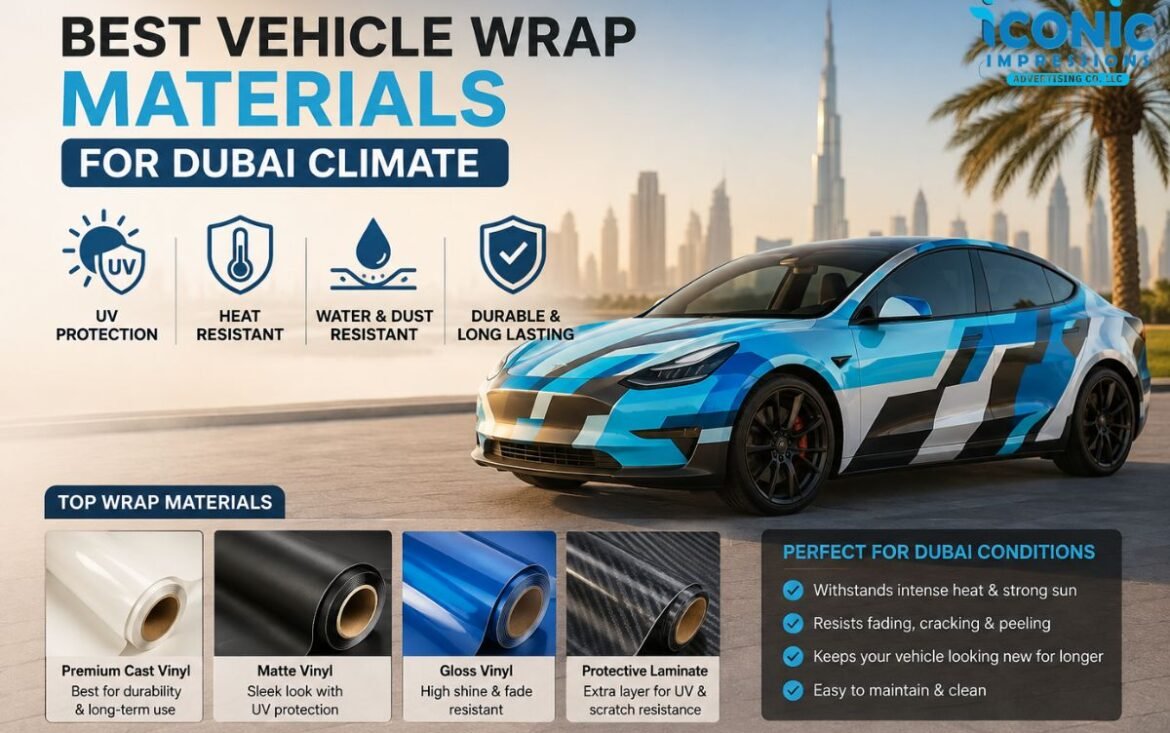
If you want to have vehicle branding in Dubai, then you need to use cast vinyl with a UV laminate. The heat in Dubai can be very extreme: on average, the month of July sees temperatures of 39.4 °С and the UV index ranging from 10 to 11 in the summer months, with considerably even higher numbers in May. In comparison with calendar vinyl, cast vinyl is produced in a way that it does not shrink or crack due to extreme temperatures. All this makes it the best option for vehicle branding in Dubai, and when combined with a cast laminate and a solvent-based adhesive, you can expect its durability of around 3-5 years in this harsh environment.
Key takeaways
- Vinyl that handles heat better than other materials by resisting shrinking and cracking.
- The UV-resistant lamination used in the wraps protects them against fading due to the excessive sunlight in Dubai.
- The adhesive used is quality enough to ensure that the car wrap remains intact and does not peel off in the sunlight.
- Dubai’s vehicle branding companies have experience preventing costs from re-wrapping on time.
Why does Dubai’s climate break ordinary wraps?
If you talk to people around and ask what they think about wrap failures in the UAE, you will likely find that they will say that the installers are to blame. But interestingly, in 90% of cases, problems are actually due to the materials. Someone made an order for vinyl that is simply unsuitable for the region, and the sun just revealed this fact in a matter of months.
The numbers show why that is. The average temperature in summer years ago was around 39-40 C. What contributes to the situation even more is that from June till September the ultraviolet index is between 10 and 11, and in May it can exceed this number. Under such conditions, unprotected materials will be damaged within a few weeks, not months, as it’s usually the case.
Wrap material that is suitable for London or Toronto can start forming bubbles or fading in Dubai. That is to say that the specifications that work elsewhere will often be insufficient in this region.
Cast vinyl vs calendered vinyl: key differences
This is the decision that determines everything else, and most businesses never get it explained properly before they buy.
Calendered vinyl is made by squeezing vinyl through heated rollers into thin sheets. It’s the cheaper option, which is exactly why some vendors push it without mentioning the trade-off. It has “memory”- it wants to shrink back toward its original flat shape, and Dubai’s heat speeds that process up. Edges lift. Cracks show up around wheel arches and door handles first, usually within a year.
However, cast vinyl is produced differently. Liquid vinyl is cast onto a sheet and cured, which leaves it thinner, more flexible, and dimensionally stable. It wraps around curves without fighting back and handles the daily expansion and contraction from heat far better.
Yes, it costs more upfront. But on any vehicle staying on the road for years, or any fleet job, that extra cost is usually cheaper than paying for a full re-wrap twelve months later.
The role of lamination
Cast vinyl on its own still isn’t enough here. The laminate on top is what actually shields the printed graphics from UV.
Skip it, and ink visibly fades within a year under the Dubai sun. Add a proper cast laminate, and the same graphic can hold its color for 3 to 5 years. Two main options:
- Gloss laminate – slightly better UV resistance, higher shine, common where brand colors need to stay punchy
- Matte laminate – less glare, often preferred for premium or minimalist branding, marginally weaker UV protection than gloss in most product lines
Furthermore, cutting lamination to save a bit of budget is probably the single most common corner cut in local vehicle branding work. It’s also usually the first thing that fails.
Adhesive type matters more than people think
The heat affects more than the surface finish. It also decides how well the wrap actually stays stuck. A vehicle parked outdoors here can have a body panel temperature well above the surrounding air, sometimes past 60°C on dark metal in direct sun.
Therefore, solvent-based adhesives generally hold up better than water-based ones since they cure into a bond that stays stable at high temperature. It’s also worth asking about repositionable air-release adhesives, the kind with tiny channels that let trapped air escape during install. They cut down on the bubbling that shows up when a wrap gets installed in a hurry.
If your installer never brings up the adhesive type, or can’t explain the difference when asked, that’s a fair reason to keep shopping.
Comparison table: wrap materials at a glance
| Material Type | Heat Resistance | Typical Lifespan in Dubai | Best For |
| Calendered Vinyl (no laminate) | Low | 6–12 months | Short-term promotions, temporary campaigns |
| Calendered Vinyl + Laminate | Moderate | 1–2 years | Budget fleet branding, flat panel vehicles |
| Cast Vinyl (no laminate) | High | 1.5–2.5 years | Simple color changes, low-detail graphics |
| Cast Vinyl + Cast Laminate | Very High | 3–5 years | Full vehicle branding, curved panels, long-term fleets |
Common mistakes businesses make
A handful of patterns keep showing up on wraps that fail early. Price gets picked over heat rating, every time. Lamination gets dropped to shave a few hundred dirhams off the quote. Installs happen at midday, when panel temperatures make adhesion worse no matter how good the material is. And every “vinyl wrap” quote gets treated as roughly the same product, when the actual grade being installed can vary a lot between vendors.
None of this shows up on day one. Most of these mistakes surface around month eight or nine, right when the wrap starts peeling at the edges.
What a reliable vehicle branding company should offer?
Not every provider works with the same grade of material, and that gap rarely gets mentioned upfront. A trustworthy vehicle branding company in Dubai will tell you exactly which vinyl brand and laminate they’re using, and why, without having to be pressed on it.
What to look for:
- Cast vinyl named specifically, not just “premium vinyl,” which means nothing on its own
- Lamination included as standard on full wraps, not sold as an add-on
- A clear explanation of adhesive choice based on your vehicle type and where it parks
- A written warranty, since climate-appropriate materials typically come with 3+ years of coverage
If one quote comes in noticeably lower than the rest, ask what material it’s actually using. That one question usually tells you everything.
Expert insights from the field
Fleet operators tend to underestimate how much parking habits affect wrap lifespan. Two identical vans, same wrap, same install date- the one parked in a shaded compound overnight will still be holding up a year or more after the one left in open sun starts fading.
Base color matters too, just less dramatically. Dark vehicles heat up faster than light ones, which shaves a bit off the wrap life on black or dark grey vans compared to white. It’s not a huge factor on its own, but stack it with a few years of Dubai summers, and it starts to matter.
Final thoughts
Vehicle branding in Dubai comes down to material choice before it comes down to design. The climate here isn’t forgiving of standard wrap products, and the businesses that get the most out of their branding budget are usually the ones that pick cast vinyl with proper UV lamination the first time, rather than finding out the hard way after a wrap fails early.
Moreover, if you’re comparing options for vehicle branding services in Dubai, ask specifically about vinyl type, lamination, and adhesive before you even look at price. Iconic Impressions Advertising works with materials built for exactly this climate, so branding holds up through the summer instead of needing a redo by next year.
Frequently asked questions
A cast vinyl wrap with proper lamination typically lasts 3–5 years in Dubai. Cheaper calendered vinyl without lamination often fails within 6–12 months.
Usually, yes. It resists shrinking and cracking far better than calendered vinyl, which means avoiding an early re-wrap that ends up costing more overall.
Darker colors absorb more heat and can fade a little faster, though lamination quality still matters more than color choice overall.
It can, but it’s not ideal. Extreme midday heat affects how the adhesive cures, so early morning or evening installs tend to hold up better.
Gloss gives slightly stronger UV protection and more shine. Matte offers a subtler finish with a marginally shorter lifespan under intense sun.
Every 6 months is reasonable. Check edges, mirrors, and door handles first, since those areas show wear before flat panels do.
Yes, noticeably. Vehicles parked in shade consistently outlast ones left in open sun, sometimes by a year or more over the wrap’s life.
For short-term promotions or events under a year, calendered vinyl can make sense. For fleet branding, it’s usually not worth the risk.
Reputable providers using cast vinyl and cast laminate typically offer 3+ year warranties. Anything shorter usually signals lower-grade material.
Yes, when it’s removed properly by someone experienced. Rushed or careless removal is what damages paint, not the wrap itself.