

-
Iconic Impressions Advertising
- September 1, 2026
- Comment (1)
What Is a Step-and-Repeat Backdrop? Complete Guide for Events
Table of Contents
- Key takeaways
- What is a step-and-repeat backdrop?
- Why do events rely on them?
- Backdrop stand types to know
- Picking the right supplier
- Fabric popup stands vs traditional frames
- Printing quality that actually holds up
- Comparison table: backdrop options
- Common mistakes to avoid
- Expert tips
- Conclusion
- Frequently asked questions
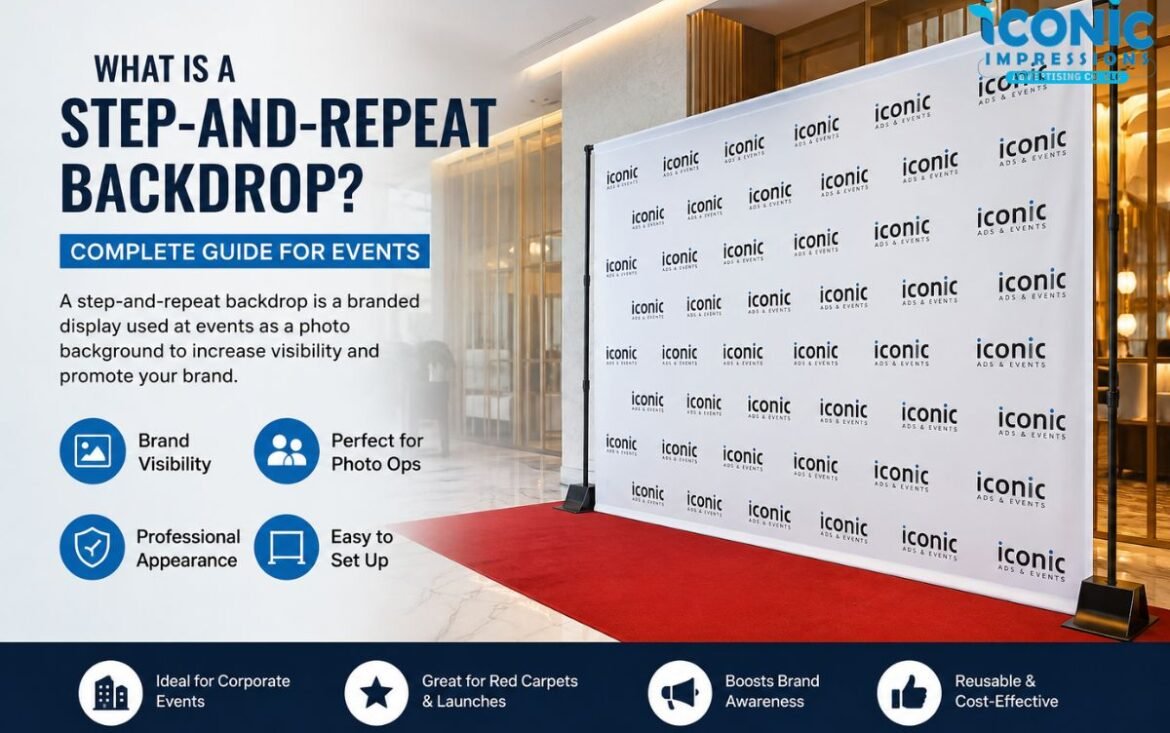
A step-and-repeat backdrop is a tall printed panel containing either a brand logo or a design. The backdrop is placed behind photo or interview areas to ensure visibility of the brand in all pictures.
Event managers typically use these banners during press conferences, awards, product launches, and exhibitions. The Dubai event industry is expected to reach AED 9.61 billion in value this year and grow to AED 13.15 billion by the year 2031. Nevertheless, exhibitions and conferences make up the largest part of this industry.
A large quantity of MICE events take place in Dubai. Therefore, the demand for a dependable provider of backdrops in Dubai is on the rise.
Key takeaways
- Backdrops that have been stepped-and-repeated ensure the logos stand out in photographs taken at both red carpet events and media events.
- Strong stands prevent wobbling that can spoil images.
- Fabric pop-up systems are more custom than PVC banners and take up less space.
- The result is better images because of the fabric’s resolution and weight.
What is a step-and-repeat backdrop?
The name refers to the process of creating the graphic. A logo or pattern is applied to a grid and repeated continually until the whole backdrop is full. This technique is probably familiar to you if you saw one at a movie premiere or product launch but did not know its name.
Therefore, photographers appreciate the graphic design because the repetition allows the logo to be caught on the photo irrespective of the guest’s point. If the logo is in the middle of the photo, it can simply be cut out. However, with a repeated logo, this is almost impossible.
Most commonly, the backdrop can be between 6 and 10 feet wide and between 7 and 8 feet tall. But sometimes, with bigger projects, you might have a backdrop bigger than 20 feet in width. It depends on the number of people in the specific frame and the venue provided.
Why do events rely on them?
Brand visibility is the obvious reason, but it’s not the only one. A backdrop also gives a photo area structure. Without one, guests end up posing against a plain wall, a fire exit sign, or whatever happens to be behind them.
There’s a practical side too. Press and media teams often need a consistent visual for every interview shot at a multi-day event. A backdrop stays put, looks the same in every frame, and doesn’t need re-lighting between guests the way a bare stage might.
Corporate clients in particular ask for this at:
- Product launches and press conferences
- Award ceremonies and gala dinners
- Trade show booths and exhibition stands
- Retail openings and franchise launches
Backdrop stand types to know
The stand holds just as much weight as the print. A great graphic on a cheap frame still sags, tilts, or catches wind indoors from an AC vent, and that shows up in every photo taken.
There are a few stand categories worth knowing before you order:
- Telescopic pole stands: the most common type, with height and width that adjust using twist locks
- Tension fabric frames: the graphic stretches drum-tight over an aluminum frame, without wrinkles
- Pop-up magnetic frames: panels click into a magnetic frame, the fastest option to assemble
- Fixed-panel stands: rigid and sturdy, better suited to permanent installations than touring events
For teams that reuse the same backdrop across multiple venues, an adjustable backdrop stand Dubai setup is usually the better call. The ceiling heights of venues vary throughout the city, and while a universal height frame can work in one hotel ballroom this month, next month it can be too short by two feet for another venue.
Picking the right supplier
This is where many events tend to lose money without knowing about it. Inexpensive suppliers usually compromise on quality and resolution of the prints, make use of weak poles which bend easily during transportation, and seldom offer same-week wrap-up in case of last-minute design changes.
A good backdrop stand supplier in Dubai must show you real fabric weight samples and print clarity rather than merely showing you mock-ups through PDFs. Be sure to ask the supplier how they package the frame for transportation purposes, if they provide setup in the venue, and the turnaround time for rush orders before your launch date.
Moreover, it is important to inquire about warranty conditions regarding the hardware itself. Poles and locking mechanisms take a beating over dozens of events, and a supplier who stands behind their frames for at least a year is telling you something about build quality.
Fabric popup stands vs traditional frames
PVC banners used to dominate this space. They’re cheap, and they print fast, but they crease permanently once folded, and creases show up as visible lines under stage lighting.
Fabric has mostly taken over for a simple reason: it packs down small and doesn’t crease the same way. A folded fabric panel can go straight from its carry bag onto a frame with barely a wrinkle, while a folded PVC banner needs steaming or ironing before it looks presentable again.
Working with established Fabric Popup Stand suppliers in Dubai also means access to magnetic-edge systems, which snap the fabric onto the frame in under two minutes per panel. Compare that to a traditional grommet-and-bungee setup, which can take fifteen minutes per panel and usually needs two people.
The trade-off is cost. Fabric systems run higher upfront than basic PVC, though most event teams recover that difference within two or three uses since the panels hold up to repeated folding without visible wear.
Printing quality that actually holds up
Resolution decides whether a backdrop reads clean in photos or looks blurry once someone zooms in. Anything printed under 150 DPI at final size tends to show pixelation in close-up shots, which is exactly the kind of shot press photographers take at these events.
This is where large format digital printing services in Dubai matter more than most planners assume going in. Wide-format printers designed for banner and backdrop work typically output at 720 to 1440 DPI, and the difference is visible the moment a camera flash hits the panel. Color accuracy matters too. Brand colors printed slightly off can look fine on a screen proof and then read completely wrong under warm stage lighting.
Furthermore, material choice affects the outcome as well. Backlit fabric behaves differently from blockout fabric, and a supplier who understands the difference will ask what kind of lighting your venue uses before recommending a material, not after the print is already running.
Comparison table: backdrop options
| Feature | PVC Banner | Tension Fabric | Pop-Up Magnetic |
| Setup time | 10 to 15 min | 15 to 20 min | 3 to 5 min |
| Crease resistance | Poor | Excellent | Good |
| Print sharpness | Moderate | Sharp | Sharp |
| Portability | Bulky | Compact | Very compact |
| Best for | One-off, budget events | Repeat corporate use | Frequent travel between venues |
| Typical lifespan | 1 to 2 uses before wear shows | 50+ folds | 30+ folds |
Common mistakes to avoid
Ordering the wrong size tops the list. Planners often measure the wall space without accounting for the stand’s footprint, then find the frame doesn’t actually fit once it’s assembled on site.
A few others worth flagging:
- Skipping a physical fabric sample and approving only a digital mockup
- Forgetting to confirm venue ceiling height before ordering a fixed-height frame
- Assuming any printer can handle large-format work at photo-quality resolution
- Not budgeting time for on-site setup and lighting checks before doors open
Expert tips
If an order for backdrops requires revisions, place order at least 2 weeks in advance of the launch date. Things like rush jobs will occur but will be more expensive and won’t allow for a re-print if the color is wrong.
If using a brand colour, always ask for a mini print sample before the full order, particularly if it is important to have a perfect colour match. Screen and printer colors don’t match.
When your team hosts several events each year, it makes sense to develop a relationship with a single backdrop stand supplier in Dubai instead of looking around continually. When placing orders in the future, repeat suppliers have an idea of your brand specs, fabric weight and your turnaround needs, making it easy to avoid the back-and-forth of each order.
Conclusion
A step-and-repeat backdrop looks simple from the audience’s side, but the stand, the fabric, and the print resolution all decide whether it actually photographs well. If one of them is incorrect, it looks cheap on camera even if it was a good design.
Whether you are considering a stand, planning a press event or setting up a booth at an exhibition, Iconic Impressions Advertising can take you through the various stand options, fabric samples and print turnaround before you place an order.
Frequently asked questions
The typical size for most is 6 to 10 feet wide by 7 to 8 feet tall for standard press shots. When using group photos, the bigger the activation, the wider the photo is likely to be, sometimes as wide as 20 feet across panels!
Normal turnaround time is 3-5 business days after printing and 15-20 minutes on-site for assembly (depending on stand type and whether setup is performed by a technician).
Fabric does not crease as easily and will hold up over a number of events. PVC is less expensive but generally looks tattered after only one or two foldings and unfoldings.
Yes, most telescopic and tension-frame stands can be adjusted in height and width, which is important as the ceiling height varies significantly between venues in Dubai, such as ballrooms and outdoor tents.
For close-up and press photography, ask for no less than 720 DPI. Lower resolution images might be acceptable at a distance, but will pixelate a lot when close-ups of faces are made.
Not always. Pop-up magnetic frames are quick and easy to setup with just a few minutes. It’s generally safer and quicker to have a trained and experienced tension-fabric wall or multi-panel wall installation.
The variety of sizes, fabrics, and prints can cause costs to range, so rather than a flat price, it’s best to get a specific quote based on your exact size and fabric type.
Yes, if it is sufficiently generic. Many teams print a base panel with the event date on one side and partner logos on the other, which allows for flexible use as well.
Light-through fabric for illuminated displays and blockout fabric that blocks any light. If you are lighting from behind, you will want to have a background that provides adequate lighting. If you’re lighting from behind, you’ll need a proper background that can be adequately lit.
If there is still time to make design changes, 2-3 weeks is the best time frame. Rush orders of less than a week are sometimes possible, but typically are more expensive and have fewer reprint opportunities.
1 Comment
Backdrop Stand Sizes Explained: Find the Right Size for Events
[…] attending multiple events a year and your booth allocation isn’t consistent, an adjustable backdrop stand Dubai setup is the better buy nine times out of ten. You’re not replacing the frame every time […]