
-
Iconic Impressions Advertising
- July 28, 2026
- No Comments
What Thickness Acrylic Should You Choose for a Display Stand?
Table of Contents
- Key takeaways
- Why does acrylic thickness actually matter?
- Common acrylic thicknesses and what they’re used for
- How to choose the right thickness for your display?
- Mistakes businesses make when ordering acrylic displays
- Why does working with suppliers make a difference?
- When does custom thickness matter?
- Caring for your acrylic display long-term
- Wrapping up
- Frequently asked question
Key takeaways
- The acrylic thickness varies depending on the kind of display, its weight, strength, and requirements for time performance.
- Thin sheets of acrylic that measure from 2mm to 3mm can be used for lightweight signboards and simple applications.
- A thickness of 5mm is needed for free-standing displays and shelves.
- Expert fabrication allows for eliminating issues with any warping, cracking, or performance before the installation takes place.
Order an acrylic display and be thrust into confusion within a week. Either it fails to stand up properly, or it looks ridiculously thick next to other products. There is very little room for variations when it comes to presenting the product to the customer.
For the thickness, most displays would have some thickness ranging between 2mm and 10mm. Where exactly the piece falls into this range depends on the dimensions of the piece, how much weight it carries, and where it is to be displayed. As an example, a tabletop card holder and a standing display brochure in the mall cannot undergo the same treatment.
At Iconic Impressions Advertising, we get this question constantly, usually from someone who already ordered the wrong thickness once and is trying not to repeat it. This is the answer we’d give them over coffee, just written down.
Why does acrylic thickness actually matter?
Acrylic isn’t interchangeable across gauges. A 2mm sheet, as well as a 10mm sheet, behaves quite differently, which will affect the longevity and appearance of the product from the very first day.
Besides, thin acrylic bends very well, meaning that it can be used for curved signage or light wall installations but cannot be used where the piece is expected to stand on its own or bear weight without any framework. However, thick acrylic retains its shape but is heavier, more expensive, and may appear clunky if a civilised look was intended.
There’s a climate angle too. Direct sun through a window will soften acrylic slightly over time, and thin sheets warp under that kind of stress faster than thick ones do. It’s not dramatic, just gradual, until one day the sign has a visible bow in it.
Get the thickness right up front and you skip the reorder. You also skip the version where a customer notices your display stand wobbling and it changes how they think about the brand for a second.
Common acrylic thicknesses and what they’re used for
Rough breakdown from what we build most often.
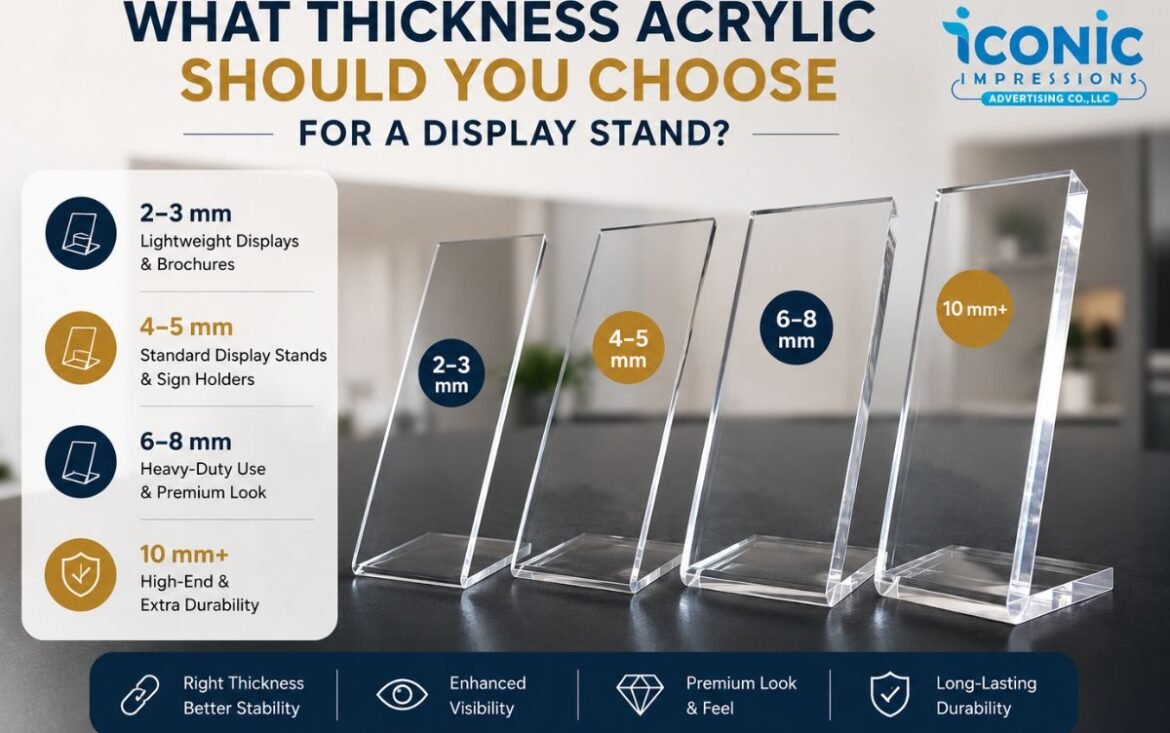
- 2mm to 3mm: Small Panels and Light Signage
Fine for wall-mounted signs, name plates, flat panels that don’t carry any weight beyond their own. Cheap, easy to cut into detailed shapes. Not built to stand on its own.
- 4mm to 5mm: The Standard Stand
This is what most brochure holders and tabletop signs end up using. It’s the range where you get enough rigidity to stand upright without needing it to feel heavy or cost more than it should.
- 6mm to 8mm: Retail Fixtures
Product shelves, jewelry cases, countertop risers, anything actually holding weight day after day. Go thinner than this and you’ll see sagging within a few months.
- 10mm and Up: Structural Pieces
Floor units, large signage frames, anything that gets bumped or leaned on regularly. Additionally, common for trays that see heavy counter use, where you’d rather overbuild than replace it in six months.
How to choose the right thickness for your display?
There’s no single formula, but a few questions tend to sort this out fast.
- What are you actually displaying? A stack of brochures is a different load than a shelf of retail products.
- Is it wall-mounted or freestanding? Mounted pieces borrow rigidity from the wall, so they can go thinner. Freestanding pieces have to do it alone.
- How much foot traffic is nearby? A display in a quiet corner ages differently than one in a busy mall entrance that gets bumped weekly.
- Sun exposure? Indoor signage away from windows has more flexibility on thickness. Anything near glass or outdoors should go up a size to resist warping.
One thing worth knowing: the price gap between 4mm and 5mm is usually smaller than people assume, and the durability difference isn’t. If you’re stuck between two sizes, go with the thicker one.
Mistakes businesses make when ordering acrylic displays
A handful of these show up across almost every industry we work with.
- Choosing on price alone- The cheapest sheet up front is often the most expensive one over a year, once you count the replacement.
- Forgetting where it’s going- A display that’s fine in an air-conditioned showroom might not survive near an entrance with regular sun.
- Treating all acrylic as equal- Cast and extruded acrylic behave differently at the same thickness. Clarity, strength, and finish all shift.
- Skipping the branding math-Cutouts, engraving, printed logos, all of it can weaken a thin sheet slightly. Worth factoring in before you order, not after.
Furthermore, most of this gets caught with one conversation before the order goes in, not after the piece arrives.
Why does working with suppliers make a difference?
Picking a thickness off a spec sheet only gets you so far. A acrylic display stands suppliers in Dubai built for retail spaces and climate has seen what holds up and what doesn’t, in ways a generic thickness chart can’t tell you.
There’s also the practical side. If a prototype comes back and something feels off, a local supplier can adjust it without your timeline getting eaten by shipping delays.
Therefore, most of our repeat clients at Iconic Impressions Advertising didn’t come back because the first order was perfect. They came back because when something needed tweaking, we turned it around fast.
When does custom thickness matter?
Standard thicknesses cover most jobs, but not all of them. Unusual shapes, oversized pieces, or displays combining more than one material usually need something custom.
Therefore, a curved reception counter might use a thinner sheet that can be heat-formed, backed by a thicker panel for support. Custom jewelry cases often mix thicknesses in one piece, thin where it needs to be delicate, thicker at the base where the weight sits.
That kind of build usually comes out of an actual design conversation, not a catalog order, which matters if your piece doesn’t fit a standard category to begin with. Acrylic trays suppliers in Dubai will help you to know the right thickness.
Caring for your acrylic display long-term
Thickness handles durability. Maintenance still matters on top of it.
- Clean with a soft cloth and mild soap. Skip anything ammonia-based, it clouds the surface over time.
- Keep it away from prolonged direct heat where you can, especially thinner pieces.
- Check mounting points now and then, particularly on freestanding units that get moved around.
- Store spare units flat instead of leaning them against a wall. Leaning is how warping starts.
Moreover, pick the right thickness and take basic care of it, and the display holds up for years instead of months.
Wrapping up
Picking acrylic thickness comes down to matching the material to the job: what it’s holding, where it sits, how much handling it takes. Thin for light, mounted signage. Thick for anything freestanding, heavy, or out in the weather.
Still not sure which one fits your display? Better to sort it out before the order ships than after something warps. Acrylic indoor signs in Dubai can help you out.
Reach out to Iconic Impressions Advertising if you want a straight answer on thickness, finish, and design before you commit to an order.
Frequently asked question
4mm to 5mm covers most tabletop stands. Enough rigidity to stand on its own without adding unnecessary weight or cost.
Not necessarily. Thickness affects strength, but quality also comes down to whether it’s cast or extruded acrylic, plus how it’s finished.
It can, especially thin sheets left in direct sun for long stretches. Going thicker or keeping it indoors cuts that risk a lot.
Most acrylic trays suppliers in Dubai use 6mm to 10mm, depending on the tray’s size and what it needs to hold.
For small, wall-mounted signs, yes. For anything freestanding or in a high-traffic area, no.
If the shape is unusual, or you’re combining materials, a bespoke acrylic products supplier in Dubai is worth talking to before you order standard.
Cast holds up better against scratches and looks clearer. Extruded costs less but won’t last quite as long.
Yes, and it’s common in custom work, thinner acrylic for detail, thicker for the parts doing structural work.
With the right thickness and basic upkeep, several years is normal before you’d see real wear.
No. Acrylic indoor signs in Dubai can usually go thinner since they’re not fighting UV and heat the way outdoor signage does.